U.S. equities posted modest gains in the third quarter as a resilient economy and strong corporate earnings offset the pressure of higher interest rates and geopolitical volatility. The S&P 500 Index added 2.3% in the three months ended September 30; performances diverged with the Russell 1000 Value Index returning 2.6%, and the Russell 1000 Growth Index eking out gains of 0.9%. Rate-sensitive segments struggled over the period, with the Russell 2000 Index declining 7.2% as higher borrowing costs weighed on smaller balance sheets. Non-U.S. markets underperformed as a strong U.S. dollar and tighter financial conditions dampened returns. The MSCI Emerging Markets Index ended in the red, falling 0.4%, as South Korean and Taiwanese equities faced sharp pullbacks following their AI-fueled surge through the first half of the year.
Bonds faced a challenging quarter as yields pushed meaningfully higher. In September, The Federal Open Market Committee (FOMC) unanimously voted to raise rates by 25 basis points, to a range of 3.75% to 4.00%—the first-rate hike since 2023—describing the move as having “removed a dose of accommodation.”
In response, market-implied Fed rate expectations shifted sharply toward a tighter policy stance, with markets pricing in an additional 100 basis points of tightening through the end of 2027; expectations for the December 2027 policy rate rose to 4.8% by quarter-end, up from 3.89% at the start of the quarter. U.S. Treasury yields rose across the curve in the third quarter, with the 10- and 30-year yields finishing at 5.27% and 5.62%, respectively. The 83 basis points surge in 10-year yields ranks among the largest quarterly yield increases of the last 40 years. This move was driven almost entirely by real interest rates, rather than expectations of higher long-term inflation, which remain anchored. Rising yields created a duration drag across core fixed-income markets: the Bloomberg U.S. Treasury Index fell 3.0% in the quarter, while the Bloomberg Long Treasury Index lost 8.0% over the same period. Outside the U.S., sovereign bond yields faced similar pressure. In France, the 10-year yield spread over German Bunds widened to 124 basis points by the end of the quarter, reaching levels last seen during the Eurozone sovereign debt crisis, underscoring heightened fiscal stress in the region. Conflict in the Middle East remained a persistent driver of volatility in energy markets throughout the quarter. Spot WTI crude rose above $100 per barrel during the period amid escalations in the U.S.-Iran conflict, up 28.1%. Supply tightness extended into the refined products market, with diesel crack spreads hitting record highs due to limited global refining capacity. Global energy reserves remain severely depleted, with U.S. Strategic Petroleum Reserves sitting at 40-year lows, posing ongoing supply risks if geopolitical tensions persist.
We view the current yield environment as an opportunity to ensure portfolios have adequate safe-haven exposure. We suggest investors rebalance back to strategic targets. We also continue to recommend investors fully utilize the portfolio risk budget and maintain a U.S. equity overweight within public equity allocations given the supportive macro backdrop and exposure to broad-based earnings strength unique to the U.S. market.
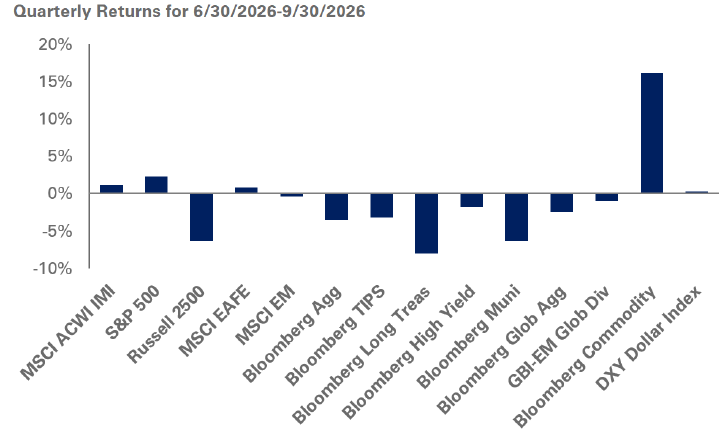
As of 9/30/2026, Source: S&P, Russell, MSCI, JPM, Bloomberg, Factset