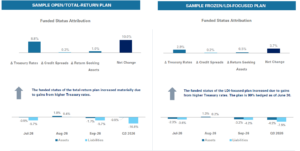
Domestic and international equities posted modest gains in the third quarter of 2026. Persistent inflation concerns led the Federal Reserve to raise interest rates by 25 basis points. Treasury rates rose, resulting in higher pension discount rates. The resulting decline in liability values led to a significant improvement in funded status for many plan sponsors.
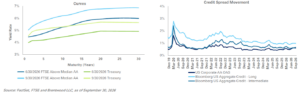
For the three months ending September 30, the 30-year Treasury yield increased 73 basis points to 5.64%. During this period, credit spreads widened four basis points but remain at historically tight levels. The discount rate for the open total-return plan increased 86 basis points to 6.58%, and the discount rate for the frozen LDI-focused plan increased 87 basis points to 6.41%. As a result, the funded status of our total-return and LDI-focused plans rose by 10.0% and 3.7%, respectively.
Total-return plans may want to consider the impact of higher discount rates on plan liabilities and the role of LDI and other de-risking strategies in the current rate environment to help protect funded status. For certain plan sponsors, higher rates may reduce liabilities and improve funded status, potentially leading to lower required contributions and PBGC variable-rate premiums. NEPC consultants are available to discuss the implications, costs, and potential benefits of various pension finance and de-risking strategies in light of interest rate movements and market volatility.
Sources: FactSet, FTSE and Brentwood LLC, as of September 30, 2026
 Rate Movement
Retiree Buyout Index
The Buyout Index for retirees is estimated to be approximately 106.8% of PBO, as of September 30, 2026.
Recent Insights from NEPC
Treasury Yields Touch 5%. What’s Next?
2026 Defined Benefit Plan Trends and Analysis | NEPC
Recent Corporate Pension Headlines
A Massachusetts federal judge dismissed AT&T from a proposed class action lawsuit regarding an $8.05 billion pension risk transfer to Athene Annuity and Life Assurance Co., ruling that AT&T had delegated selection responsibility and was not involved in choosing the provider. However, the court allowed claims to proceed against the independent fiduciary, State Street, finding potential liability for the decision. The ruling highlights a growing shift in pension risk transfer litigation, where plan sponsors that outsource decision-making without red flags are increasingly protected from ERISA breach-of-fiduciary-duty claims.
The trend continues to be favorable for plan sponsors, as no new pension risk transfer litigation has been brought since IBM in September 2025. To the best of our knowledge, four cases are still outstanding. NEPC will continue to monitor the situation and report updates.
PRT sales were down 26% year-over-year based on the latest data through the second quarter from LIMRA. The decline is largely attributed to transaction timing, deal sequencing, and deal-size mix rather than a drop in long-term demand. Of note, there were no transactions above $250 million during the second quarter.
Sources:
LIMRA. (2026, August 13). LIMRA: U.S. pension risk transfer sales total nearly $3 billion in second quarter 2026. LIMRA. https://www.limra.com/en/newsroom/news-releases/2026/limra-u.s.-pension-risk-transfer-sales-total-nearly-$3-billion-in-second-quarter-2026