In this final installment of a three-part series on VEBAs, we discuss the benefits of liability driven investing.
Incorporating Liabilities into the Investment Strategy
A Voluntary Employees’ Beneficiary Association (VEBA) offers a range of investment approaches. This final installment explores how a Trust’s unique characteristics and the plan sponsor’s circumstances can shape the selection of an optimal investment solution. While most VEBAs have traditionally pursued a total return approach, we believe a liability driven investing (LDI) framework is appropriate in certain instances. We will outline our rationale for LDI and review a case study in which two plans overseen by the same governance committee pursue different investment strategies.
The Case for LDI When Managing VEBAs
Similar to pension plans, plans funded through VEBAs have regulatory and record-keeping reporting requirements that require actuarial valuations and projected benefit cash flow streams. Pension plan sponsors have embraced LDI as an additional risk management tool to help manage funded status and contribution volatility while preserving the potential upside of a long-term investment approach. We believe VEBAs can take a page from the LDI playbook, adapting the approach to each plan’s unique circumstances. An LDI glide path, a predefined framework for managing risk at different funded status levels, may also be considered for these types of plans.
Below, we outline reasons why an LDI strategy with a glide path may be appropriate for VEBAs with a funded status above 80%:
1. There are limited benefits of a material surplus for the VEBA unless asset transfers are a future consideration. Some plans may start generating unrelated business income tax (UBTI) beyond a certain funded status, and reversion of assets to the plan sponsor is sub-optimal given the 100% excise tax. As a result, an LDI approach can help the plan sponsor reach and maintain an optimal funded status that mitigates exposure to the unintended adverse impact of a material surplus.
2. Plan liability values can be volatile from one year to another due to changes in assumptions, demographic experience, and discount rate movements. If an investment strategy is agnostic to the liabilities, funded status can become volatile. Incorporating an LDI allocation can help mitigate this volatility by aligning the investment strategy with the plan’s funding source and benefit obligations.
3. While actuarial valuations are typically generated annually, there are tools that can estimate and monitor the plan’s funded status more frequently. These include daily monitoring—an essential component of an LDI framework—which could allow quicker implementation of investment decisions and portfolio adjustments to better capture market opportunities.
4. Plan sponsors can implement a glide path that incorporates a de-risking and re-risking structure to offset the impact of the “un-hedgeable” actuarial factors that increase the volatility of VEBA liabilities. This differs from glide paths for pension plans, which generally de-risk as funded status improves, but does not automatically re-risk if funded status declines.
5. A de-risking and re-risking glide path incorporated into the investment policy statement can streamline plan governance by reducing the need for committees to deliberate on each asset allocation change. When managing the plan relative to liabilities, asset allocation changes can occur frequently, as funded status may experience wide swings after an actuarial valuation is performed or during periods of increased market volatility.
Depending on a plan sponsor’s governance policies, deliberating on proposed changes can be cumbersome and may result in missed opportunities as markets evolve rapidly. A two-way glide path can provide a framework for timely investment decisions while reducing the burden on investment committees.
Challenges of Using LDI When Managing VEBAs
While we see merit in adopting LDI where appropriate, it is important to consider the practical challenges and potential trade-offs of this approach. In general, hedging liabilities with a high degree of precision is challenging as liability discount curves are not investable and some actuarial assumption changes are un-hedgeable.
This may introduce noise in the investment strategy; therefore, we believe it is important to set appropriate expectations and understand the strategy’s limitations. We recommend periodically reviewing funded status attribution to help stakeholders understand the drivers of change and identify any unexpected outcomes.
For instance, for health and welfare plans with participant benefits tied to healthcare inflation, finding an investment instrument that precisely hedges this risk can be challenging. Inflation-sensitive proxies may offer a practical alternative, helping to offset liability growth driven by inflation.
While we have highlighted a few challenges, these are not exhaustive; some plans may have unique circumstances that may make some or all elements of an LDI approach less suitable.
Practical Management of Two Years
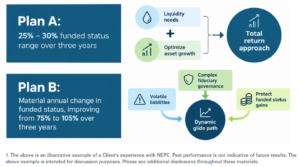
In this case study1, we outline how NEPC worked with a governance committee overseeing two plans, A and B, in different industries. Initially, both plans started with a total return strategy (70% equity, 30% fixed income), where funded status for A and B was 30% and 75%, respectively. Equity risk in both plans was diversified through multi-asset strategies, while modest exposure to private credit was added to capture the potential illiquidity premium.
Over time, the funded status for Plan A ranged between 25% and 30% while Plan B rose to 105% from 75%. Plan A’s sponsor was in an industry that experienced short- to medium-term economic challenges but eventually recovered. As a result, it had to annually adjust its benefit payment and contribution policies based on the company’s financial health. Plan B saw its funded status rise to 105% from 75% in three years, with average annual changes exceeding 10%, partly attributable to actuarial liability adjustments.
NEPC proposed that Plan A continue to pursue a total return approach, prioritizing liquidity needs over asset growth. As a result, the plan’s asset allocation shifted to a more balanced allocation of equities and fixed income, while retaining exposure to some diversifying strategies and ceasing commitments to new private credit funds.
Plan B adopted a two-way dynamic glide path to enable more responsive adjustments to asset allocation. This improved plan governance by enabling more timely responses to material changes in funded status as asset allocation changes previously required committee approval. In the end, the plans pursued different investment strategies that considered funded status, healthcare inflation, benefit payment method (that is, redeeming from trust assets or “pay as you go”), contribution policy, liquidity needs, and the financial health of each subsidiary.
Conclusion
A liability-driven investing approach can be an appropriate solution for some plans, provided plan sponsors carefully consider various factors, including funded status, liabilities, governance structure, and risk tolerance, to determine how best to implement the strategy.
Given the broad range of plans and plan sponsors’ circumstances, our review of these factors is not exhaustive; however, we have covered some of the common factors that can help to shape an investment strategy. We encourage you to reach out to your NEPC consultant to learn more about VEBAs and explore a customized investment solution tailored to your plan’s unique needs.