The bond market came into sharp focus in September as yields marched higher around the world, with investors reacting to renewed pressure in energy prices and a shift toward tighter monetary policy. The Federal Open Market Committee raised its policy rate by 25 basis points to a range of 3.75%-4.00%—the central bank’s first hike since 2023—noting the move “removed a dose of accommodation.” In response, yields increased across the curve with the 10-year Treasury yield climbing 53 basis points for the month, while the 10-year German Bund and 10-year Japanese government bond yields also pushed higher, rising 25 and 13 basis points, respectively.
The higher-rate backdrop proved to be a headwind across fixed-income returns, driving a 2.6% decline in the Bloomberg U.S. Aggregate Bond Index, while long-duration indexes underperformed with the Bloomberg Long Treasury Index losing 5.0%. In credit, lower-quality securities also came under pressure, with option-adjusted spreads on the Bloomberg U.S. High Yield Index widening 50 basis points in September and returns falling 2.5% during the same period.
Despite the challenging rate environment, equities took the higher yields in their stride. The S&P 500 Index fell a modest 0.3% with growth stocks remaining resilient as the Russell 1000 Growth Index added 2.2%; its value counterpart lost 3.1%. Other rate-sensitive areas also underperformed, with the Russell 2000 Index down 5.3% and the NAREIT Composite Index in the red with losses of 6.0% in September. Outside the U.S., equities were pressured by the tighter policy backdrop and a stronger U.S. dollar, with the MSCI EAFE Index falling 3.1%, and the MSCI Emerging Markets Index declining 0.6%.
Commodities remained a bright spot as tensions between the U.S. and Iran persisted alongside concerns around supply disruptions; spot WTI crude oil gained 3.8%, while the broader Bloomberg Commodity Index added 0.6%.
We encourage investors to utilize the portfolio risk budget. We continue to recommend an overweight to U.S. stocks within public equity allocations, given the resilient macroeconomic backdrop and earnings strength across the U.S. market. With recent pressure in rates, we advocate investors hold high-quality, liquid assets, and suggest maintaining safe-haven fixed-income securities at strategic target levels to support portfolio liquidity.
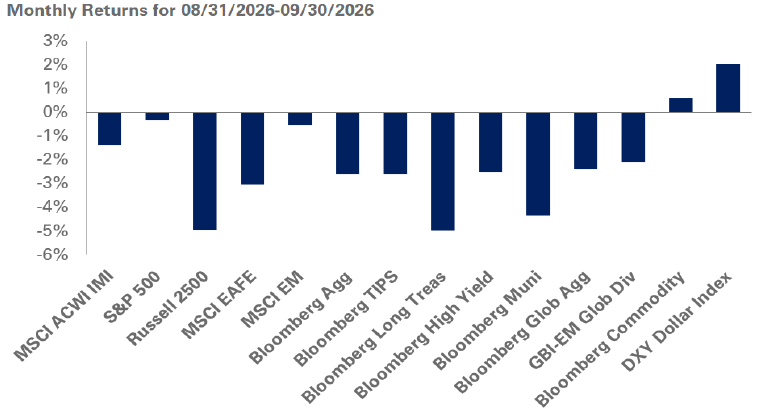
As of 9/30/2026, Source: S&P, Russell, MSCI, JPM, Bloomberg, Factset