Insurers are facing greater investment complexity as portfolios expand beyond traditional fixed income and public equities.
An evolving landscape with shifting capital considerations, higher yields, broader access to private markets, and continued pressure on surplus and profitability has added additional nuances to investment decisions, fueling a need for a broader and deeper array of resources. For insurers, we believe navigating these dynamics requires greater insight and specialized expertise, making an experienced investment consultant an increasingly valuable partner.
This paper explores the different ways investment consultants can help insurance companies strengthen investment oversight and advance their long-term objectives. For instance, for smaller and mid-sized insurers, an investment consultant can effectively extend the capabilities of the internal investment team. The relationship can be tailored to the insurer’s needs, ranging from traditional advisory services to an outsourced chief investment officer (OCIO) model.
Meanwhile, for larger insurers with more established internal teams, an investment consultant can provide targeted expertise and an independent perspective. An insurer can engage a consultant for a specific asset class or investment strategy while retaining responsibility for the rest of the portfolio.
At NEPC, we believe the most effective consulting relationships—be it in the capacity of an advisor or an OCIO—are flexible partnerships designed to support an insurer’s objectives, governance framework, and internal resources.
The Increasing Complexity of Investment Oversight
The need for a thoughtful investment approach has grown as insurers face multiple pressures. Volatility in underwriting results seems to be rising, making it difficult to rely solely on operating performance to support surplus growth. For example, P&C insurers have had to navigate a challenging claims environment amid higher inflation, while health insurers are facing escalating medical costs and a more complex claims environment. Across the insurance industry, higher operating costs have heightened the importance of investment portfolios as a meaningful contributor to overall company results.
At the same time, the investment landscape has become harder to navigate. Insurers that once relied primarily on high-quality fixed income and public equity now have access to a much broader opportunity set, including private markets and more specialized credit strategies. This expanded opportunity set can be valuable, but it also requires more time and resources to evaluate manager quality, liquidity terms, fees, vehicle structures, capital treatment, and overall portfolio fit.
Against this backdrop, we find that insurance companies are increasingly evaluating the role of an investment consultant. The goal is to enhance the resources available to the company while preserving the elements of the portfolio and governance framework that have served the organization well. In many cases, we’ve observed that the most effective consulting relationships are practical partnerships: an extension of staff, a source of investment research and perspective, and a way to bring broader institutional resources to a portfolio.
At NEPC, we believe this type of partnership can be especially valuable for insurers of all sizes.
For small- to mid-sized insurers, the scope of services might be broad and cover all parts of the investment process. Insurers can gain access to a range of research, performance reporting, and specialized investment expertise that may be difficult to maintain in-house. Under an OCIO arrangement, insurers can leverage the full breadth of the consultant’s resources and investment capabilities.
For large insurers, consultants can supplement in-house capabilities with specialized private markets research, serve as a sounding board for investment decisions, and bring forward differentiated ideas and perspectives. In all instances, a consultant can help add capacity, discipline, and perspective without changing the company’s ultimate responsibility for its investment program.
Below, we explore how an investment consultant can support insurers, drawing on over three decades of experience working with insurance companies.
Consultant Use Cases
An Extension of Staff
Insurance portfolios require a wide range of investment resources: asset allocation, manager research, risk analysis, capital-aware implementation, reporting, and ongoing monitoring. A consultant can expand the resources available to the organization by providing direct access to consulting teams, research professionals, and subject matter experts across public and private markets.
Insurers with a large in-house investment staff may still value an outside partner as an independent perspective, a sourcing engine for new ideas, and a way to compare internal views with broader market research. In an ideal relationship, the work is collaborative. The insurer brings knowledge of its business, balance sheet, liabilities, and risk tolerance, and the consultant brings investment depth, governance perspective, and experience across many different types of portfolios.
Building a More Diversified Investment Portfolio
Historically, insurance company portfolios have been heavily weighted toward high-quality investment-grade fixed income and, sometimes, a complementary allocation to public equities. That structure may still make sense given the role of the general account and the importance of liquidity, book yield, capital charges, and downside protection. However, we believe there may be opportunities to enhance the portfolio over time by utilizing a broader opportunity set.
In our view, portfolio evolution should be approached thoughtfully and deliberately, while being aware of the potential impact on capital charges and realized gains/losses. For some insurers, the progression may include new investments into illiquid private markets, niche credit markets, for instance, private placements, real estate debt and high-yield credit, or other insurer-friendly strategies such as tax-managed equities. For insurers already invested in these asset classes, diversification may involve accessing a broader range of institutional-quality managers or improving the structure of existing allocations.
In both cases, the overarching objective is to create a more robust portfolio that can support sustainable income and total return, while remaining aligned with the company’s risk profile, liquidity needs, tax considerations, and capital position.
Navigating Private Markets
Private markets are a prime example of where additional resources and specialized expertise can add value. The opportunity set is vast, the terminology can be complex, and the range of strategies, vehicles, fees, liquidity terms, and capital treatment can vary meaningfully. For insurers that already invest in private markets, the challenge is often sorting through a large and expanding landscape of strategies and mangers. For insurers starting a private markets program, the first step may be understanding how private markets work and where they fit within the broader general account portfolio.
A consultant can help define the role of private markets, identify appropriate strategies, evaluate managers, and build a long-term pacing plan. The work does not end at commitment. Private markets also require ongoing monitoring of capital calls and distributions, performance measurement, liquidity planning, and governance around re-ups or new commitments. For insurers, partnering with an investment firm that understands both private market strategies and the unique requirements of insurance portfolios can help make the process more efficient and effective.
Education Support
Even when an insurer has a clear investment strategy, implementation often requires significant coordination among managers, custodians, legal teams, operating platforms, and internal decision makers—particularly when entering a new asset class. This creates yet another avenue where an experienced investment consultant can provide valuable support.
NEPC offers a flexible service model designed to navigate these operational hurdles. Some clients may want to retain discretion over strategic asset allocation and manager selection but need help with implementation. In these cases, we can support execution, including coordination with investment managers, legal review, and fee negotiations. Other clients may want a more fully delegated OCIO relationship where investment manager selection is also outsourced. The right model depends on the insurer’s governance structure, internal resources, and comfort with discretion.
A Partner for Investment-Related Issues
One of the more valuable aspects of a consulting relationship is that the scope can be fairly broad as insurance investment programs touch many parts of the organization, including finance, accounting, actuarial and risk management.
We find that an open-ended partnership works well for insurers. The relationship should give clients the flexibility to pick up the phone and talk through any issue, whether it involves a new investment idea, a manager concern, a board question, a capital consideration, or a policy update. Direct access to investment researchers and experienced consultants can help insurers make more informed decisions, while providing the support and perspective needed to navigate an increasingly complex market.
Putting It All Together
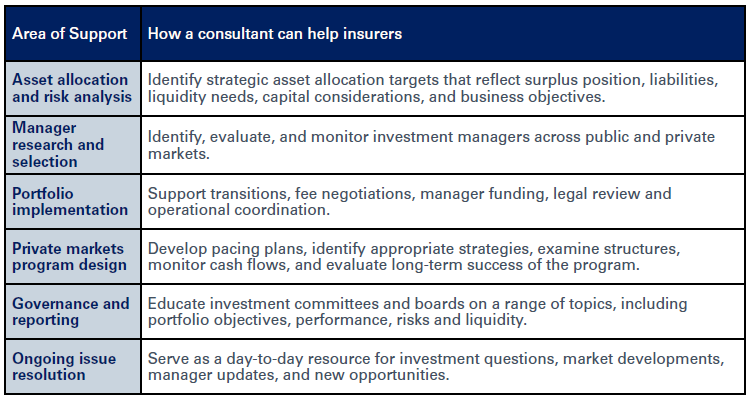
The scope of a consulting relationship can vary by client; for insurers we find it often involves a combination of strategic advice, manger research, implementation support, and ongoing portfolio monitoring. The areas below are not meant to be exhaustive; rather, they reflect the types of issues that frequently arise in our existing insurance general account relationships.
In many cases, the biggest challenge is simply making the initial connection. Some insurers may be less familiar with the ways a consulting relationship can be tailored to their specific needs. At the same time, consultants may have limited visibility into the companies that could benefit most from additional investment resources.
For insurance companies, the right partner can provide additional capacity, broader investment perspective, and practical support across a wide range of portfolio issues. Importantly, we believe in a flexible partnership designed around the insurer’s objectives, governance structure, and internal resources.
To learn more about how we support insurance companies, or to explore how an investment consulting relationship could benefit your organization, please contact NEPC.