Anthropic’s anticipated IPO could mark a pivotal moment for institutional investors, bringing increased scrutiny to liquidity in private markets, portfolio concentration, and the evolving relationship between private and public investments in artificial intelligence.
The transition of Anthropic—the AI company behind the Claude chatbot—from a privately-held company to a publicly-traded security raises important considerations for portfolio management. Institutional investors may face overlapping private and public exposure, changing valuations and liquidity expectations, and potential shifts in risk for the total portfolio. The IPO could also establish a valuation benchmark for other privately held AI companies, influence capital flows across the venture ecosystem, and accelerate the need to reassess pacing, rebalancing and liquidity plans in private-market investments. Ultimately, investors will need to understand how these developments affect their broader investment programs and ensure their AI exposure remains intentional and aligned with portfolio objectives.
At NEPC, we can help our institutional clients navigate these evolving dynamics by evaluating AI exposure across the total portfolio and assessing the implications for portfolio construction, liquidity, and risk management. Our goal is to help our clients make informed decisions that ensure their exposure is deliberate, appropriately sized, and aligned with their broader investment objectives.
Anthropic has indicated an expected offering range of $70 to $78 per share, implying a fully diluted valuation of approximately $1.3 trillion to $1.4 trillion, up from the $965 billion valuation established in a round of private financing in May 2026.¹ As with any IPO, the stock’s post-offering performance remains uncertain. Anthropic’s S-1 filing highlights several material risks, including competitive pressures, significant computing and capital requirements, regulatory uncertainty, and challenges related to the development, safety and potential misuse of advanced AI technology.2 Importantly, near-term trading performance should not be viewed as a reliable indicator of the company’s long-term prospects.
Additionally, recent volatility in public markets tied to AI-related companies has also raised concerns that a weaker-than-expected Anthropic IPO could put downward pressure on valuations across the private AI landscape. There are already signs of pressure: OpenAI reduced its current fundraising target from approximately $30 billion to $20 billion and lowered its targeted valuation to roughly $1.25 trillion from the approximately $1.4 trillion discussed earlier in October, the Financial Times reported on October 30.
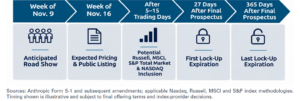
1 Source: CNBC, November 10, 2026. “Anthropic sets IPO price range of $70 to $78, looks to start trading Nov 19, sources say”. https://www.cnbc.com/2026/11/10/anthropicsets-
price-range-of-70-to-78-in-upcoming-ipo.html
2 Source: Anthropic, PBC, Registration Statement on Form S-1 and subsequent amendments
For Institutional Private Investors, an IPO Isn’t Always an Exit
For institutional private-market investors, an IPO can change how Anthropic is valued. The company may become publicly traded well before investors fully exit their private-market positions, creating a period of overlapping exposure and added complexity for portfolio management.
Managers are likely to reference the public share price when updating fund valuations after the listing, though practices may differ during the lockup period. The result could be a meaningful change in reported NAV without an immediate distribution of cash or shares to limited partners.
The path to liquidity may also vary meaningfully by manager. Lockups, governance rights, and fund-specific considerations could leave some managers holding Anthropic for a year or longer, while others may distribute shares in stages as restrictions expire. Institutional investors receiving shares in kind should consider establishing a plan before distributions begin, including engaging a broker to help assess market sentiment, liquidity, and potential trading conditions around Anthropic. Staggered releases could create concentrated selling windows, making a measured liquidation approach preferable to automatic sales.
The appropriate approach will depend, in part, on whether Anthropic represents a modest exposure that can decline naturally or a meaningful exposure that warrants more active rebalancing. Taxable investors should also coordinate with their tax advisors before selling distributed shares.
Understand Exposure Across the Entire Portfolio
For institutional investors and plan sponsors, evaluating Anthropic should begin in the context of the broader portfolio. We believe the first step for institutional investors tackling this complicated dance is to develop a reasonable understanding of existing Anthropic exposure across venture funds, co-investments, secondary vehicles, and public-market allocations. While precision may not be possible, investors should be able to distinguish between exposure that is modest and exposure that could materially influence portfolio outcomes.
(a) Where Exposure Appears Modest
For institutional investors with relatively modest exposure, the practical initial approach may be to let the IPO, lockups, and eventual realization process play out. The focus should then shift to monitoring whether appreciation, purchases by active managers or index inclusion cause that exposure to become more meaningful before the private position declines.
(b) Where Exposure Appears Meaningful
Where exposure appears meaningful, the issue becomes one of portfolio construction and risk management. The objective is not necessarily to reduce the exposure, but to determine whether its size and role remain in line with the investor’s objectives, especially during a period when a large, illiquid private position may overlap with new public-market exposure.
One useful way to frame this risk is to compare the Anthropic position with the largest individual securities elsewhere in the portfolio. Consider an institutional investor with 60% of its portfolio in global public equities. For instance, if Apple represents roughly 5% of the MSCI ACWI, that translates into an approximately 3% position at the total-fund level. Viewed through that lens, an Anthropic exposure of approximately 3% or more of the total portfolio begins to look less like an underlying venture holding and more like a meaningful single-company position. At that size, Anthropic can become a driver of portfolio outcomes in much the same way as the largest public-market holdings, warranting a more active conversation around concentration, liquidity, and risk management.
Consider another example where an institutional investor with a 15% allocation to private markets. Through several underlying venture managers, Anthropic has grown to represent approximately 4% of the total fund, leaving roughly 11% in the rest of the private-markets program. At that size, the position requires a more engaged discussion around concentration, liquidity, and its interaction with future public-market exposure. The investor has several potential levers to deploy:
- Establish a distribution and rebalancing plan. If Anthropic represents a meaningful exposure, the investor should decide before the liquidity event how distributed shares or sale proceeds will be treated. The investor could sell shares gradually as lockups expire, retain a portion as a distinct public-market position, or use proceeds to rebuild the strategic private-markets allocation or fund another need of the portfolio. A predetermined plan can reduce the risk of retaining shares by default or selling automatically into a crowded release window.
- Consider hedging but recognize its limitations. A direct hedge may be difficult while private holdings remain locked up, and proxy hedges introduce basis risk. Following the IPO, limited float and potentially elevated volatility could also make options or short positions expensive. Therefore, hedging may be more appropriate for a defined period or specific risk objective, rather than as a simple solution to a longer-term concentration issue.
- Integrate Anthropic exposure into broader portfolio construction decisions. Initially, the investor could continue to count Anthropic within the existing 15% private-markets allocation, while monitoring it separately as a concentrated exposure. This requires no immediate portfolio change. As Anthropic migrates into public markets, however, the investor should reassess total exposure as active managers or benchmarks begin to add the company. That reassessment may influence private-market pacing and public-market positioning. discussion around concentration, liquidity, and its interaction with future public-market exposure. The investor has several potential levers to deploy:
-
- Private-market pacing: Future commitments could be sized with existing Anthropic and broader AI exposure in mind. A post-IPO mark-up could push a private-markets program further above target in the near term, while later distributions could leave the program underweight. Investors should remain disciplined but incorporate expected liquidity into 2027 pacing rather than reacting only after distributions arrive.
-
- Public-market positioning: If private Anthropic exposure remains elevated while the company enters active portfolios or public indexes, a more risk-averse investor could reduce public-equity or technology exposure to help accommodate the resulting concentration. This would reduce broader equity or technology risk rather than provide a precise offset to Anthropic.
-
The objective is not to suggest that every institutional investor needs a precise, continuously updated estimate of its Anthropic exposure. Complete look-through data may not be practical across every manager or portfolio. The more useful distinction is whether the exposure appears modest enough to monitor or meaningful enough to address explicitly through portfolio construction, pacing, and liquidity planning.
NEPC can help institutional clients put these developments into context and determine whether their existing investment strategies remain appropriate as private AI companies transition into public markets. We encourage clients to connect with their NEPC consultant to discuss potential implications for their portfolios and identify opportunities to proactively address emerging risks.