This article is part of NEPC’s Investment Conference Insights series, featuring perspectives from our investment professionals on the key themes, market trends, and investment challenges discussed at the 2026 NEPC Investment Conference.
Session Highlights
- Delegation is accelerating. In a recent NEPC client survey, 75% of organizations reported delegating key decision making to staff or an outsourced chief investment officer (OCIO).
- Education is a common pain point. In the survey, 25% of institutions identified Board and Committee education as their primary governance challenge.
- Boards are becoming more strategic. Boards are shifting focus away from execution and towards high-level policy and strategy.
Within the institutional sphere, governance is rarely a topic that grabs attention. But in NEPC’s experience, effective governance programs play an outsized role in an organization’s ability to perpetuate its mission.
Anecdotally, we have seen institutional clients grappling with significant change and mounting pressures with regards to governance. To move beyond anecdote and capture real-time feedback from our network of institutional leaders, we surveyed 74 organizations in April 2026 to capture feedback on their governance views and practices. The survey included NEPC clients and other organizations; ranging from sub-$500 million endowments to $5 billion+ healthcare systems and corporate pensions, with a wide range of missions and objectives.
The response data clearly shows that institutional governance is evolving, and that new best practices are emerging. This conference session focused on a few of the most compelling themes highlighted by the survey. Click here for full survey results.
Analyzing Challenges
Utilizing NEPC’s proprietary analytical frameworks, NEPC’s analytics team used the survey data to identify the structural shifts and pain points that are driving organizational transformation.
The most telling findings, in our view, reflect rising pressure on organizational leadership to expand their knowledge base and to hand off complex or time-consuming tasks, creating more capacity for strategy and oversight.
- 75% of organizations reported delegating more authority to staff or an OCIO as the most impactful structural change to their governance model.
- Board and Committee education ranked as the largest pain point by far across governance practices, at 25% of respondents.
Emerging Best Practices for Institutional Governance
Delegation
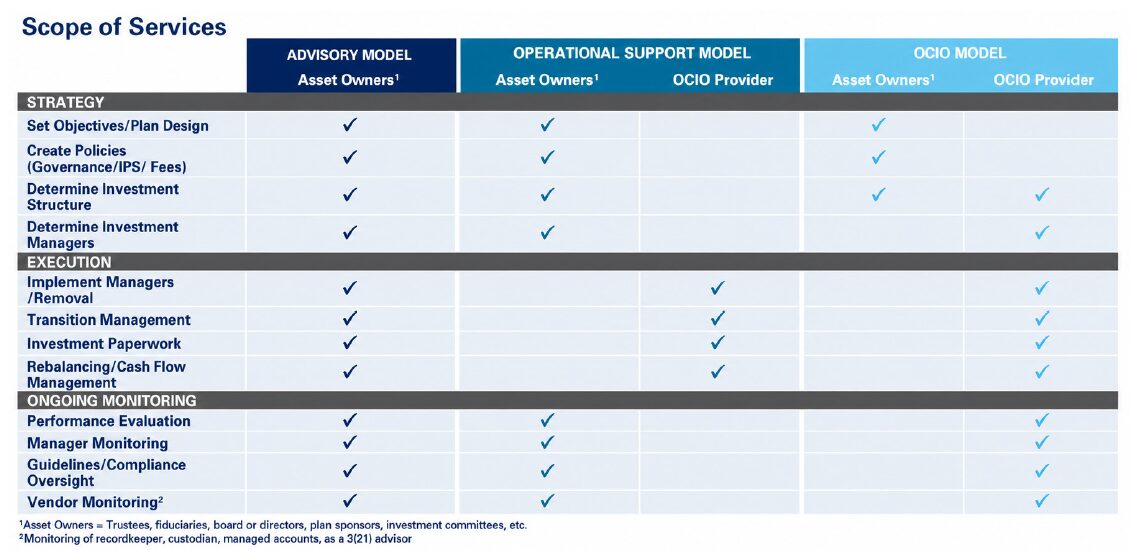
One of the most striking insights generated by NEPC’s analysis is the rapid acceleration of delegation.
- Strategic asset allocation remains firmly in the hands of the Board (33%) and the Investment Committee (53%).
- Implementation and rebalancing activities, however, have shifted heavily toward operational leads or external partners, with internal staff (41%) and OCIOs (16%) taking the reins on execution.
This data underscores a structural shift: Committees and Boards are defining their role around strategic oversight while empowering others to execute day-to-day decisions. Ideally, this approach puts the right expertise in the right places to succeed, and it allows organizations to remain nimble in volatile markets without sacrificing fiduciary responsibility.
Navigating Delegation
Education as an Ongoing Process
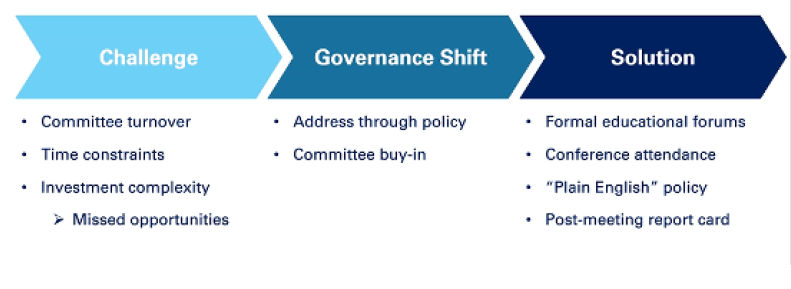
It was not surprising to us to see education rise to the top of governance pain points, because there are numerous ways that education deficits can impact Board decision making. For example, Boards can struggle with questions around what governance includes, or how Boards should govern themselves, or what foundational knowledge new Board members must come up to speed on.
However, investment-oriented education deficits are typically the most problematic to quality decision making, and the trend toward delegation can compound the problem. Delegation solves for speed and execution, but it introduces a new challenge: ensuring that fiduciaries fully understand the complex strategies being deployed on their behalf. Meaningful investment opportunities or solutions can disappear in the time it takes to educate Board members about it.
Institutions are reporting that these challenges are best addressed by codifying education directly into governance policy and treating it as an essential ongoing responsibility. Here are four data-driven solutions we’re seeing take shape across institutions:
- Annual educational forums. Institutions have begun implementing a mandatory half-day or full-day educational forum yearly, or immediately after new committee members are seated. Driven by consultants like NEPC, these sessions bring in outside experts to establish a baseline understanding of complex asset classes before critical decisions need to be made.
- Regular conference attendance. Governance policies should set an expectation for committee members to attend at least one national or regional investment conference every other year (and during their first year for new members).
- The “plain English” mandate. Committees can benefit by enforcing a strict “plain English” policy, requiring all vendors and consultants to define complex terms in real-time, and encouraging committee members to demand clarifications.
- Post-meeting report cards. Committees can enhance learning and retention, and drive improvements in future meetings, by instituting a formal report card at the end of every meeting
 Enhance Meeting Efficiency and Strategic Focus
Effective education and delegation can reduce demands on Boards and free up valuable time during committee meetings, potentially allowing leadership to construct better strategy in less time. NEPC’s survey data reveals that this shift is already underway.
Investment Committee and Board meetings are becoming less frequent but significantly more intentional. The proportion of organizations meeting four times per year or fewer has grown. More importantly, NEPC’s analysis of meeting agendas shows a distinct reallocation of time:
- Policy and strategy discussions now consume 30% of average meeting content, up from 26%
- Investment performance and administration have seen a corresponding decrease, dropping from 30% to 25%.
The survey data clearly showed that oversight and governance are becoming more strategic, more intentional, and more results oriented. This tighter focus, combined with hybrid and virtual meeting structures, allows meetings to be more efficient and accessible, and potentially to speed decision making.
Conclusion: Navigating the Future with Data-Driven Governance
Investment governance is not static: it is a dynamic, evolving discipline. Organizations are actively recalibrating how their oversight is structured, where authority is delegated, and how their Committees and Boards engage with increasingly complex investment programs.
Navigating this transformation requires more than experience. In our view, it requires empirical evidence and robust analytical support. NEPC is utilizing these findings to help clients ramp up their governance capabilities and build governance structures that are resilient, agile, and aligned with their long-term missions.
Source: NEPC Governance Survey Data as of April 28, 2026