For sophisticated taxable investors, portfolio gains are typically paired with an unwelcome companion: a growing unrealized tax liability. In recent years, investors concerned about their tax exposure have sought out more aggressive tax management strategies, and that has fueled interest in leveraged long/short tax extension strategies.
Long/short strategies seek to generate tax losses more efficiently than traditional tax-management approaches, but their leverage, costs, and structural complexity mean they are not a universal solution. This paper explains how the strategies work, examines their potential benefits and risks, and outlines which investors are – or aren’t – best positioned to use them.
From Long-Only Direct Indexing to Long/Short Tax Extension Strategies
Long-only direct indexing has historically served as a popular strategy for tax-loss harvesting. These strategies track a broad market index while opportunistically harvesting losses at the individual security level. The approach can be effective, especially in the early years, but that effectiveness may diminish over time. Over an extended period, an increasing share of individual holdings are likely to be sitting on gains rather than losses. At that point, tax-loss opportunities can decline or disappear entirely – a condition known as an “ossified” portfolio.
A run of strong market gains since mid-2020 has prompted managers and investors to seek out alternatives to long-only direct indexing; leveraged long/short tax extension strategies have filled the gap. Long/short strategies are typically structured as customizable separately managed accounts with a net market exposure of approximately 100% (a beta of roughly 1), achieved through a combination of long and short positions.
As illustrated below, the portfolio’s balance of exposures is commonly expressed as a ratio – for example, 130/30 or 200/100 – in which the first figure denotes long exposure and the second denotes short exposure. A 130/30 strategy, for instance, carries 130% long exposure and 30% short exposure, which amounts to a 160% gross exposure and 100% net exposure. Providers generally offer a range of exposure levels, from approximately 130/30 to 250/150.
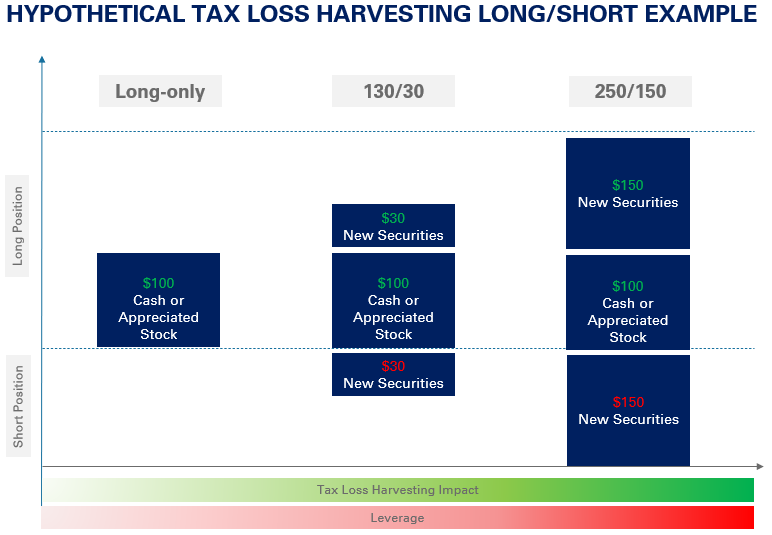
The above is provided for illustrative purposes. Please see additional disclosures at the end of these materials.
The key innovation of a tax extension strategy is to include short positions, which are capable of generating harvestable losses in rising markets. When well-managed, these strategies can produce meaningful advantages.
Advantages of Long/Short Tax Extension Strategies
• Greater loss-harvesting capacity with (approximately) market-like returns. In theory, a portfolio with a beta close to 1 should produce market returns. Meanwhile, the use of leverage and the inclusion of a substantial short position can generate many more opportunities for harvestable losses.
• Tax alpha. Studies demonstrate that tax extension strategies can meaningfully enhance after-tax returns, creating an additional source of alpha. *
• Flexibility for ossified portfolios. These strategies can restore loss-harvesting capacity in portfolios where long-only approaches have run out of losses to realize.
• Advanced planning for a future tax event. Because you can carry tax losses forward indefinitely, you can “bank” those losses toward a large, anticipated tax liability, such as a future liquidity event.
However, these potential benefits come at a cost.
*Source: https://www.morningstar.com/financial-advisors/taking-tax-loss-harvesting-next-level
Disadvantages and Risks of Long/Short Tax Extension Strategies
• Greater complexity. Leverage, short positions, counterparty exposure, and less transparent cost structures make these strategies harder to evaluate and monitor than long-only alternatives. They also carry substantial administrative burdens, including collateral management, margin requirements, and tax reporting.
• Limited access. In part because of this administrative complexity, it can be hard to find a custodian who is willing or able to open new client long/short accounts.
• Higher cost. Investors can expect elevated management fees, increased trading costs, and financing costs associated with leverage.
• Higher tracking error. While tax extension strategies seek neutral market exposure, the use of leverage and the timing of trades can introduce a meaningful amount of tracking error. *
• Tax liability is deferred but not eliminated. Harvested losses reduce a portfolio’s short-term tax burden, but the strategy also generates embedded gains. Deleveraging a long/short portfolio is likely to produce realized gains, unless you do it slowly over a period of years. Exiting the strategy entirely can be a substantial taxable event unless planned for carefully and well in advance.
Who Should Consider a Long/Short Tax Extension Strategy?
Because long/short strategies have higher costs, and since exiting them can produce a major tax bill, the approach is typically most beneficial for investors with long term horizons who can maximize the benefits of tax deferral.
In our view, long/short strategies are also appropriate for investors who wish to address a specific, identifiable tax-management objective. We have identified three such cases where we believe tax extension strategies can be especially effective.
*Source: https://www.wealthmanagement.com/investing-strategies/tax-aware-long-short-strategies-are-in-vogue-are-they-worth-it
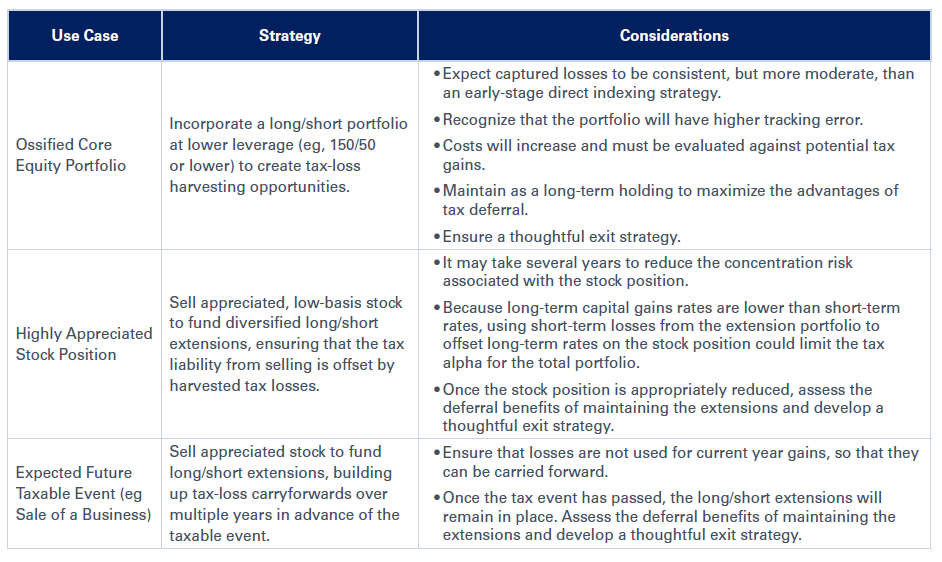
In every case, we maintain that investors who employ long/short strategies will need a well-defined strategy if they ever wish to unwind the position.
The Long and Short of It
Long/short tax extension strategies can be an excellent approach to tax management, offering enhanced loss-harvesting potential relative to traditional long-only approaches. However, this benefit is accompanied by increased complexity, cost, and tracking error, and these strategies defer rather than eliminate tax liability.
Given the range of considerations involved, investors who are interested in tax management are encouraged to talk to your partners at NEPC and tax advisors1. A thorough review can determine whether a long/short tax extension strategy is appropriate given your specific tax circumstances, investment horizon, and risk tolerance.
1 NEPC does not offer tax or legal services. The information provided in these materials has been provided for educational purposes. Nothing in these materials, included the opinions shared, should be interpreted as advice related to finance, tax or legal decisions.
Frequently Asked Questions
No. These strategies defer capital gains tax by generating offsetting losses; they do not eliminate the embedded gain, which is typically realized as a taxable event when the strategy is unwound.
It refers to the strategy’s long and short exposure: 130% long and 30% short, for 160% gross exposure and 100% net market exposure (a beta of roughly 1).
Estimates from NEPC and Parametric generally range from approximately 1% to more than 4%, depending on the level of leverage used and market conditions.
Yes. They carry higher tracking error, greater cost, and added complexity from leverage, short positions, and counterparty exposure.