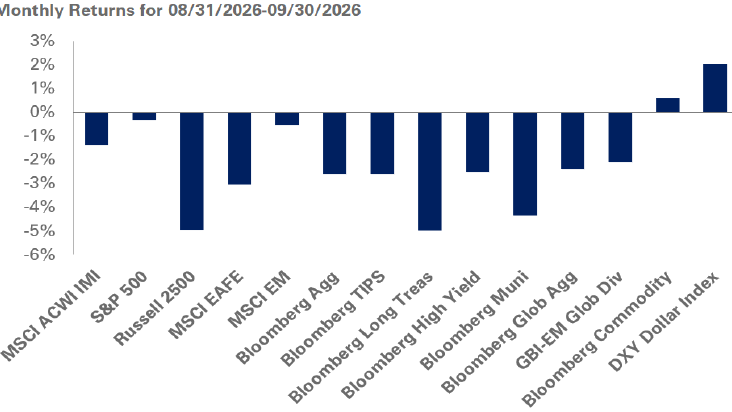
Higher interest rates have created an opportunity for insurance companies to not only capture higher yields but also strengthen their investment portfolios.
For many insurers, today’s higher yields can be used to increase prospective investment income, enhance credit quality, and reposition duration through a disciplined rotational program. By strategically selling existing holdings, insurers may be able to benefit from today’s yield environment while keeping realized losses and payback periods within acceptable ranges. The goal: a stronger portfolio that is better positioned to generate income and support the insurer’s broader organization.
At NEPC, we believe the meaningful rise in rates this year has created an opportunity for insurers to selectively sell lower-yielding securities and reinvest the proceeds into bonds offering higher yields. While these rotational programs often result in realized losses for the insurer, the additional income from the replacement securities can help offset that loss over time while improving the portfolio’s forward-looking book yield and net investment income profile. Furthermore, realized losses from selling fixed income can potentially be offset with gains from public equities which continue to trade near all-time highs. Before initiating a rotational program, insurers should coordinate with their internal accounting and investment teams, investment consultant, and third-party asset managers to evaluate the potential benefits and broader balance-sheet implications.
Timing Is Everything
Long-term Treasury yields have moved meaningfully higher in 2026, improving the yields available across high-quality fixed income. We believe the recent rise in long-term Treasury yields has been driven primarily by higher real interest rates rather than a meaningful increase in inflation expectations. While several factors, including a strong nominal growth environment in the U.S., higher oil prices fueled by an escalation in the U.S.-Iran conflict, rising bond yields in Japan, and ongoing policy uncertainty from the Federal Reserve, have contributed to the move, we do not view the increase in yields as a cause for concern. With the 10-year Treasury now above 5%1, we believe long-term investors are being offered an attractive entry point.
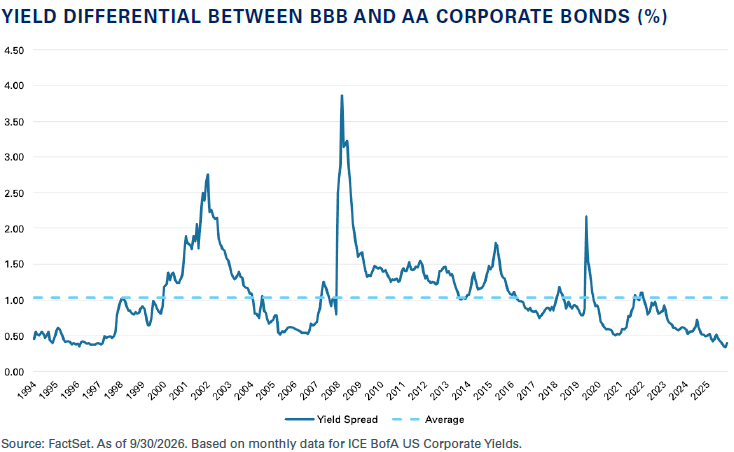
At the same time, credit spreads on corporate bonds remain at historically tight levels. In our view, the combination of higher Treasury yields, and tight spreads creates an opportunity for insurers to earn higher all-in yields while improving credit quality—without reaching for additional spread. For example, triple-B corporate bonds currently yield 6.24%, compared with 5.84% for double-A corporate debt—a difference of just 40 basis points2. At the start of the year, the yield differential was 46 basis points, well below the historical range of 80–120 basis points.
Finally, modestly extending duration may also be worth considering as part of a broader portfolio rotation. Extending duration can help offset some of the yield reduction associated with moving higher in quality, while also increasing total return potential if rates decline. Any adjustment in duration should be evaluated in the context of the insurer’s liabilities, liquidity needs, existing portfolio positioning, and risk tolerance.
Building a Rotational Program
We believe a rotational program should be deliberate and selective rather than a broad effort to sell every bond trading below book value. Insurers can begin by identifying lower-yielding holdings whose prospective income, credit profile, or role in the portfolio may no longer justify retaining them. Potential replacements can then be evaluated based on yield, quality, duration, liquidity, capital treatment, and fit with the insurer’s liabilities and investment policy. The size of the rotational program should be informed by the potential losses that will be incurred by selling out of lower-yielding bonds. We often suggest coordinating with internal accounting teams to establish a loss budget while also reviewing any other balance sheet implications.
For insurers that work with a third-party fixed-income manager, we often suggest engaging directly with the portfolio management team to identify bonds that may be candidates for sale. During these discussions, it is also important to understand how the proceeds will be reinvested and over what time frame. Most investment managers should be able to review the portfolio’s characteristics pre- and post-rotational program trades; as part of this evaluation, we also suggest reviewing portfolio benchmarks that may need to be adjusted to make room for changes to duration, credit quality, or sector allocations. Finally, once the sale and purchase candidates are identified and the necessary internal approvals are complete, a third-party manager should be able to implement the program in an orderly manner over an agreed-upon period.
A key measure is the payback period, calculated as the realized loss divided by the incremental annual income generated by the replacement security. This analysis should reflect the actual proceeds available for reinvestment—not the original par value—and should account for taxes, transaction costs, statutory accounting treatment, and the expected holding period. We believe the review should extend across the entire bond portfolio to identify holdings with lower starting yields and, therefore, more compelling rotation opportunities. This may be particularly relevant for securities purchased during the low-rate environment of 2020 and 2021, as reinvesting at today’s higher yields could have the potential to generate enough incremental income to produce a more attractive payback period.
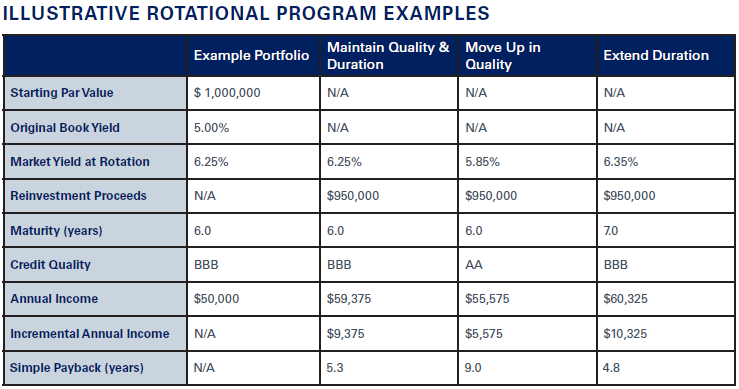
Original book yield and market yield at rotation based on market yields as of 1/1/2026 and 9/30/2026. Source of yield data: FactSet. Starting Par Value and Original Book Yield only apply to the Example Portfolio, prior to beginning a rotational program. The above is intended for illustrative purposes only and is not representative of any current or prior NEPC portfolio. The data above is an example of how higher rates might impact a rotational investment program, and it is not representative of any NEPC portfolio recommendation or product. Reinvestment proceeds assumes 1.25% increase in rates on the starting par value with an adjustment for half a year’s worth of coupon payments. Incremental annual income based on reinvestment proceeds multiplied by market yield at rotation. Simple Payback is incremental annual income divided by the realized loss (reinvestment proceeds less starting par value).
Conclusion
For insurers, higher rates present more than an opportunity to add yield with new cash; they also create an opportunity to improve existing portfolios. We encourage you to reach out to your NEPC consultant if you have questions or for our help thinking through a rotational program that might work for your organization.
1As of 9/30/2026, the 10-year Treasury yield was 5.29%. Source: FactSet.
2As of 9/30/2026. Based on ICE BofA US Corporate Yields. Source: FactSet