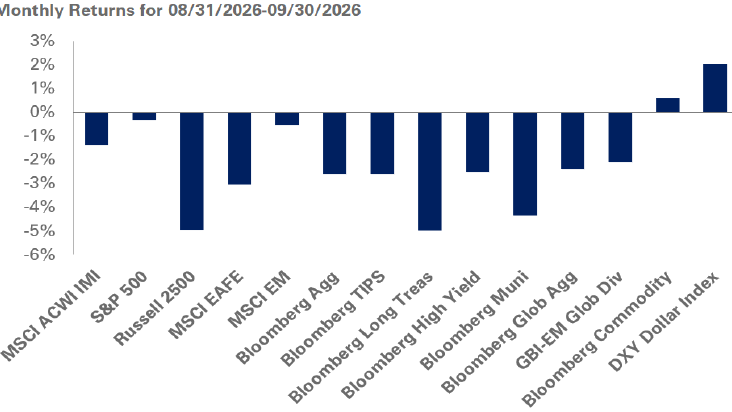
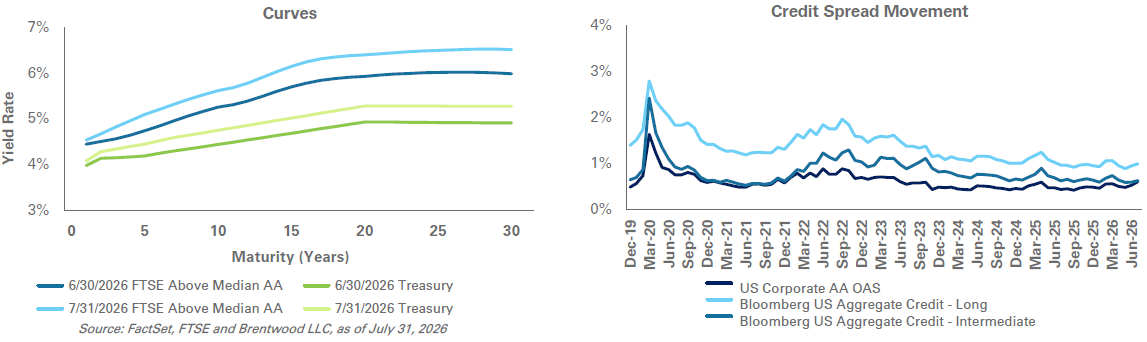
In July, pension plan sponsors likely added to year-to-date improvements in funded status. Both the hypothetical total-return and LDI-focused plans experienced improvements despite muted global equity returns. Funded ratios for both plans increased, driven mostly by the rise in Treasury yields at the long end. The Treasury yield curve shifted upward across all tenors; 10- and 30-year yields rose to 4.75% and 5.27%, respectively.
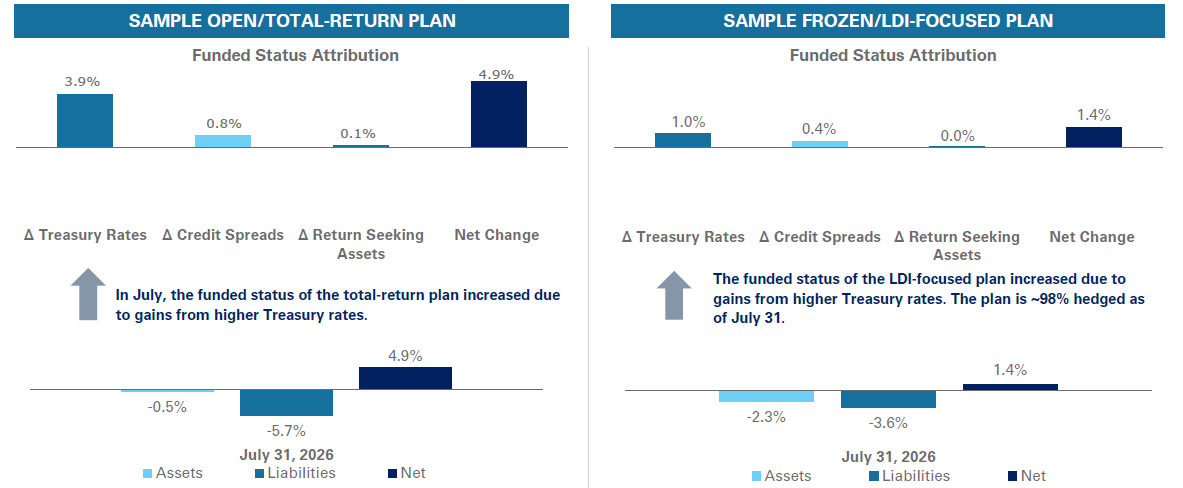
The discount rate for NEPC’s hypothetical total-return pension plan increased 43 basis points to 6.16%, while the frozen LDI-focused plan rose 40 basis points to 5.94%. The changes in Treasury rates attributed to a significant increase in funded status for the total-return plan and moderate increase for the LDI-focused plan. As a result, funded status improved 4.9% for the total-return plan and 1.4% for the LDI-focused plan.
Due to the higher discount rates and lower liabilities, some pension plans may have reached their next glide path trigger or achieved a sufficiently favorable funded position to consider de-risking. We suggest ongoing monitoring of funded status to determine whether glide path thresholds have been met, and to assess the timing and execution of any glide path implementation to help protect and preserve recent gains.
Sources: FactSet, FTSE and Brentwood LLC, as of July 31, 2026
 Rate Movement
 Rate Movement
 Retiree Buyout Index
 Retiree Buyout Index
The Buyout Index for retirees is estimated to be approximately 106.3% of PBO, as of July 31, 2026.
Recent Insights from NEPC
Unlocking Value in Private Markets: 6 Insights from the NEPC Conference
Recent Corporate Pension Headlines
The Department of Labor (DOL) and ERISA Industry Committee (ERIC) filed amicus briefs on July 21 and 22, respectively, related to the pension risk transfer (PRT) litigation case against Bristol Meyers Squibb. Both agencies urged the court to overturn a ruling that allowed the lawsuit to continue. They argue that the case lacks standing because all benefits have been delivered since the PRT as promised and there is no evidence those benefits are at risk. Further, the DOL argues that continued litigation could deter derisking activity and disrupt the balance between federal and state regulations as established by Congress. To the best of our knowledge, PRT litigation cases are still outstanding against four companies, including Bristol Meyers Squibb. PRT activity declined significantly in the first quarter, according to data from LIMRA. Total PRT sales were $3.8 billion, a 47% decline from a year ago; buyouts drove the decline, while there was continued strong growth in buy-in activity.
Sources:
U.S. Department of Labor. (2026, July 21). US Department of Labor files amicus brief clarifying use of pension risk transfers to annuity providers [News release]. https://www.dol.gov/newsroom/releases/dol/dol20260721
The ERISA Industry Committee. (2026, July 22). ERIC files amicus brief urging Second Circuit to reject meritless attack on pension risk transfers [Press release]. https://www.eric.org/press_release/eric-files-amicus-brief-urging-second-circuit-to-reject-meritless-attack-on-pension-risk-transfers/
LIMRA (2026, July 1) US Pension Risk Transfer Sales Total Nearly $4 Billion in First Quarter 2026 (News Release)https://www.limra.com/en/newsroom/news-releases/2026/limra-u.s.-pension-risk-transfer-sales-total-nearly-$4-billion-in-first-quarter-2026/https://www.pbgc.gov/documents/opinion-letter-26-001