The Macro Mixtape series is a curated collection of capital market insights told through songs that help define the moment. Consider this your essential playlist for understanding and navigating market dynamics.
Track: Under Pressure – Queen, David Bowie
The Sound Bite
U.S. interest rate expectations have shifted meaningfully since the start of the year as geopolitical tensions have ratcheted up inflation concerns against the backdrop of a still robust labor market. Rate expectations are under pressure, but market pricing may be getting ahead of itself on the Federal Reserve’s likely trajectory.
The Main Stage
U.S. rate expectations are under pressure as market pricing for interest rates has undergone a significant, hawkish repricing in 2026.1
Despite a market bracing for a higher-for-longer regime, we believe this hawkish narrative may have moved too far, too fast. While we acknowledge that interest rates may be on hold for longer than expected, we believe the hurdle for a Fed rate hike remains high.
At the start of the year, market expectations were dialed in for lower rates even with a steady bassline of lingering inflation pressures in the economy. Those underlying price pressures have since been aggravated by the closure of the Strait of Hormuz, which has disrupted global commodity markets, supply chains, and the agricultural planting season. Rate expectations have reacted to what looks to be a consistent inflationary pulse that is likely to outlast the closure of the Strait itself – and one that the market fears may require a policy response by the Fed.
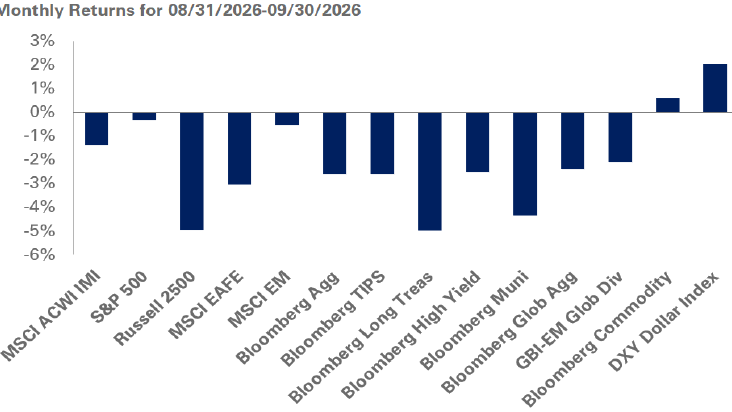
Add Friday’s chart-topping nonfarm payrolls report2 to the mix, and the paradox good news is bad news—where positive economic indicators are treated as negative signals because they may indicate an overheating economy—track is playing on repeat. As a result market returns appear to be challenged by a string of resilient economic data suggesting an easier Fed policy bias may not be in the queue this year.
Consequently, the market has changed its tune, upending the base case scenario of rate cuts in 2026, with forecasts now reflecting a Fed rate hike by year-end. Beyond this near-term shift, market pricing now reflects a bigger change in posture with tighter policy expectations embedded over the next 24 months: December 2027 rate expectations are now sitting above 4% compared to the 3.1% rate expected at the start of 2026.3 This significant shift in market pricing comes at a unique moment for new Federal Reserve Chair Kevin Warsh, who is set to take the stage for his first Fed Open Market Committee (FOMC) meeting and press conference this week. Warsh now controls the music at a time where his known bias for lower rates seems out of step with current economic data.
Markets will be listening closely to see how his setlist evolves, but it’s a high-stakes gig – especially on the back of one of the worst sessions of the year for risk assets on Friday.4
The FOMC is not a monolithic voting machine – seven votes on the 12-person committee are required to pass a rate hike and we believe that assembling a hawkish coalition of that size in the current environment does not appear highly likely. Instead, Warsh may look to manage the market noise by tapping one of the Fed’s other instruments: the balance sheet. We expect the FOMC may lean into the balance sheet reduction as a way to more quietly tighten policy, without shocking the system with an official rate hike.
Further, given that current inflation pressures seem to largely stem from a supply shock, we expect the Fed will be slow to react as historical precedent shows the central bank often tunes out exogenous disruptions that its blunt policy instruments are not well-suited to address.
Outro
Market interest rate expectations can be volatile, but don’t let the noise throw your portfolio off beat. We view the hawkish repricing of rate expectations as largely stemming from the closure of the Strait of Hormuz, and we expect any easing of supply disruptions to act as a pressure-release valve, causing policy expectations to fall sharply. However, recent data indicate that we are likely to see a tighter policy bias from the Fed than what was originally expected under a Warsh regime. As a result, we encourage investors to ensure safe-haven fixed-income exposures are in line with strategic target levels as the outsized move in rate expectations has created a relatively attractive environment for yields today.
Bonus Tracks (Other Items to Monitor)
- Upcoming U.S. Inflation Data: Softer-than-expected data may immediately take the edge off rate hike probabilities and provide a relief rally across risk assets, while a hotter-than-expected number could re-validate the market’s hawkish bias.
- The 10-Year Treasury Yield: While long rates have moved only modestly higher in 2026, we continue watching the 10-year Treasury yield as a 4.5% 10-year yield has historically been a pressure point for equities.
1Bureau of Labor Statistics, FactSet as of June 5, 2026.
2FactSet as of June 5, 2026.
3FactSet as of June 5, 2026.
4FactSet as of June 5, 2026.
5FactSet as of June 5, 2026.
Related Insights