

FIN News: Q1 2026 EM Equities Provide Opportunity Despite Geopolitics, Short-Term Headwinds
Emerging markets equities have increasingly ignited interest for institutional investors in recent months and while commitments slowed in March due in part to geopolitical issues and what the industry views as short-term volatility, these investments remain beneficial to portfolios.
. . .
“I think this trend of the best performing asset class gaining more attention and more assets generally holds true. Given that strong performance of 2025, we certainly expected emerging markets to be in vogue this year, and we likely expect continued growth,” said William Forde, head of marketable equity investments at investment consultant NEPC.
. . .
Importantly to Forde, NEPC believes that earned growth drives equity performance.
“When you look at the equity growth expectations in the EM index, it has some of the strongest expectations globally. And so, because of that, I think investors are going to be tilted toward the emerging markets for the foreseeable future here,” he said.
. . .
The big factors from a positive standpoint are some of the diversification benefits that EM provides, according to NEPC’s Forde.
“When you think about the U.S. and institutional investors likely being overexposed to growth, tech and AI, and there’s certainly some of that in the emerging markets, you get a much more diversified group of exposures investing within the EM asset class,” he said. “On top of that, you get exposure to emerging countries around the world that provide different growth trajectories relative to developed markets, which can all be diversifying depending on the overall asset allocation of the client. Some of the work that we’ve done would suggest that the rolling three-year correlations of emerging markets to developed markets has come down, therefore improved, over the past few years, providing some diversification away from a market which has been tilted more toward the Mag 7, AI and growth.”
. . .
Forde heads up Boston-based NEPC’s marketable equity investment team of 11, where 100% of their time is devoted to finding the best managers across different asset classes, including the emerging markets. He thinks the space provides a better backdrop for active management.
“When you look at 2025, you’ve seen the median manager in the EM space outperform the MSCI EM Index by about 40 basis point,” he said. “There were certainly pockets of underperformance, but generally a pretty good year, while the median U.S. large-cap manager underperformed the S&P 500 by nearly 2%. And if you zoom out and look at that over a longer period, the same trend holds true, where EM managers typically prefer better from a relative standpoint than active managers here domestically.”
. . .
Meanwhile, geopolitical risk is spread across the global market, according to Forde.
“We’re seeing it today here in the U.S., and so it’s tough for me to say that it’s any more a risk in the emerging markets. With that said, historically, EM has been a pretty volatile asset class, and investors certainly need to be aware of that when they think about the sizing of the allocation. We think the emerging markets are too big for investors not to allocate to, but understanding the volatility of the asset class should have implications on the way in which you size it, particularly relative to the broad MSCI ACWI Index,” he said.
. . .


Chief Investment Officer: As Corporate Pension Liabilities Shrink, How Does Hedging Change?
When corporate pension plan sponsors faced significant underfunding and long-duration liabilities, along with persistent low interest rates, after the global financial crisis, many pursued liability-driven-investment programs to address the critical problem.
. . .
NEPC’s annual Corporate Defined Benefit Peer Study and Survey, released in April, showed plans did not de-risk further in 2025, with the average fixed-income allocation across the consultancy’s peer group roughly unchanged year-over-year.
. . .
Matt Maleri, head of insurance at NEPC, says some pension plans are selling their long-duration fixed-income holdings, something considered unlikely five or 10 years ago, and buying in the belly of the yield curve. But he hesitates to say pension funds will no longer buy longer-duration debt.
“There are still many plans that need to buy long-duration fixed income, and there will be many that continue to hold it, but certainly you’re seeing a more emphasis and a bigger shift toward intermediate duration,” Maleri says.
. . .
Maleri says NEPC is not sold on the idea that all the bond alternatives are perfect liability matches, but for plans with heavy fixed-income and hedging assets, exploring these alternatives as diversifiers makes sense.
. . .
Maleri says NEPC is seeing many plans stick with their current investment managers, but change their mandates, such as moving into intermediate-duration bonds from long-duration bonds. Plan sponsors may need to use specialist firms to invest in nontraditional hedges, although he says more traditional LDI players are starting to offer these kinds of diversifying asset classes.
“They know they have an audience that is going to be a natural buyer of them,” he says.
. . .
Click here to continue reading the full Chief Investment Officer article.

Chief Investment Officer: DB Plans Focus on Hedging Volatility, Evaluating Options
The past few years have been great for corporate pension funds. Strong portfolio performance has improved the funded status of corporate defined benefit pensions across the board, returning most plans to funding levels not seen in more than a decade.
. . .
Most of these plans are well hedged through liability-driven-investing models. Even plans that use other investment frameworks, such as total return, saw similar increases in funded status and strong performance, according to data from Milliman and NEPC.
. . .
Matt Maleri, partner in and head of insurance at NEPC, says, “We’re seeing much more attention paid to duration exposures and trying to match liabilities across the yield curve, not just in totality—also understanding the split between credit and Treasury bonds that is needed to match their liabilities.”
. . .
NEPC’s Maleri agrees with the focus on long-term thinking.
“The purpose of an evergreen vehicle, in our view, is that you don’t need to constantly make new commitments to a fund that calls capital, draws it down and returns it,” Maleri says. “But we would caution plan sponsors that these aren’t really tools for liquidity.”
. . .
Click here to continue reading the full Chief Investment Officer article.

Business Insider: The exodus from private credit's most battered funds is spreading beyond retail investors
In March, a representative of Blue Owl, the embattled private-credit fund manager, dialed into a meeting with local officials in Columbia, Missouri.
. . .
“We have had a couple of clients participate in these funds where they have been able to drive unique economics or terms,” said Oliver Fadly, head of private debt at institutional investment consulting firm NEPC, referring to nonpublic BDCs. “Where we have also seen it a little bit is in public BDCs with folks that are looking to park capital for a shorter amount of time. It’s either a bridge or they’re waiting to move money somewhere else.”
. . .
Click here to continue reading the full Business Insider article.

ASPPA: Room for Optimism on DB Plans, Study Suggests
Defined benefit plans may not have the preeminence they once did, but they’re holding their own. In fact, more than holding their own, according to a recent study.
Funding status, interest in retaining a pension plan, plans for surplus assets, and more all auger well for DB plans, according to a report by NEPC in its 2026 Corporate Defined Benefit Peer Study and Survey. In the report, NEPC used data from survey responses from 46 plan sponsors and from the Securities and Exchange Commission 10-K reports filed by 218 plan sponsors in 2025.
. . .
The years-long trend of improvement in private pension plan funding levels that NEPC has been reporting continues, according to its findings. The level stood at 87% in 2019; in 2025 it was 16 percentage points higher, 103%. With the exception of a 1 percentage point drop from 2022-2023, the trajectory for plans in the aggregate has been consistent in NEPC reckoning
. . .
The NEPC report shows that plan liabilities as a percentage of market cap dropped by 9 percentage points during the period 2018-2025, starting at 19% in 2018 and landing at 10% in 2025. Here’s a year-to-year look:
. . .
NEPC found that surplus asset use centers on cost management. They report that their survey results indicate that most plan sponsors whose plans have surplus assets intend to use them to (1) cover future expenses related to the plan or (2) reduce potential future contributions to the plan.
. . .
The NEPC 2026 Corporate Defined Benefit Peer Study and Survey is available here.
. . .

Pensions & Investments: As DC record-keeping assets grow, small sponsors present big opportunities for the industry
Some of the biggest growth prospects for record keepers are coming from some of the smallest defined contribution plans, thanks to regulatory changes, competition for scale in a crowded market and greater interest among sponsors.
. . .
“The industry has struggled with overcapacity,” said Michael Contorno, principal and head of DC vendor management at the NEPC consulting firm, who expects more consolidation among larger record keepers.
. . .
“We have 20, but it could be eight or 12,” he said. “There are too many providers chasing clients.”
. . .
Contorno said record keepers can adjust to the crowded market by pursuing deals with PEPs. “If you’re not in it, what chances do you have to succeed?” he said.
. . .
Among the largest players, record keeping remains a scale business, especially for companies facing financial challenges when competing against the industry’s giants, said Bill Ryan, a former long-time DC plan consultant for NEPC who joined Carlyle Group in January as managing director and head of retirement solutions.
Click here to continue reading the full Pensions & Investments article.

Pensions & Investments: Plan sponsor demands drive record-keeper ‘arms race’ for digital tools, wellness services
Record keepers are expanding their services to retain existing clients and attract new ones, responding to ongoing pressure from plan sponsors, many of which are conducting searches and reviews this year.
. . .
DC consultant Michael Contorno said sponsors are focusing more on a “value for service lens — what services are they getting for what they’re paying” — than on new investments when issuing RFPs.
Their goal is: “Let’s pick a record keeper who is best for us, and the cost will work itself out,” said Contorno, principal and head of DC vendor management at NEPC.
Record keepers need improved technology to increase plan efficiency, reduce costs and provide better communication to participants. However, helping participants save more “is not solved only by technology,” Contorno said. “This is a people business. You need a strong service team.”
Click here to continue reading the full Pensions & Investments article.

Pensions & Investments: DOL private markets rule puts heavy lifting on managers, not record keepers, experts say
The proposed Department of Labor rule on private market investments in DC plans won’t have much impact on record keepers, according to some industry experts, but record-keeping executives say they will need time to review the 56 pages of fine print published in the Federal Register before making official comments.
. . .
“Most record keepers can already administer these strategies within existing platforms when packaged appropriately,” said Michael Contorno principal and head of DC vendor management at the NEPC consulting firm, referring to liquidity and daily net asset value.
. . .
Even though the DOL safe harbor proposal “reduces fiduciary uncertainty,” the heavy lifting belongs to asset managers, who must solve for things like liquidity, daily net asset valuation and cost “particularly in a DC system built on daily liquidity,” Contorno said.
Click here to continue reading the full Pensions & Investments article.

Pensions & Investments: Major consulting firms split on DC alternatives in pooled plans
While the drumbeat grows for incorporating alternatives into defined contribution plans, consulting firms are split on whether to include those investments in their pooled employer plans — some are holding off despite mounting pressure from the industry while others have already begun adding private real estate and infrastructure to those plans.
. . .
On March 16, NEPC became the latest investment consultant to announce it was launching a PEP, allowing unrelated businesses to join together in a single, shared DC plan.
NEPC’s plan — Stratum One — will be available beginning May 1.
Mikaylee O’Connor, partner and DC team leader at NEPC said in an interview earlier this month that the firm has “spent decades advising plan sponsors on best practices in governance, investments, and fees, and the timing felt right to apply that experience within a PEP structure as the market continues to mature.” NEPC has $1.9 trillion in assets under advisement.
One asset class that won’t be part of NEPC’s PEP, at least initially, is alternatives.
“We believe adoption (of alternatives) should be thoughtful and deliberate,” O’Connor said. “Our approach is to prioritize simplicity, transparency, and cost efficiency — particularly important considerations for pooled plans with diverse participating employers and participant demographics.”
She noted the firm will continue to monitor regulatory developments, market innovation, and evolving best practices, and “may consider private or alternative investments in the future where they clearly enhance participant outcomes and can be implemented in a fiduciary‑prudent manner.”
Click here to continue reading the full Pensions & Investments article.
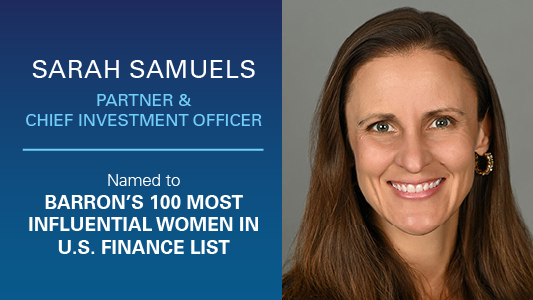
Barron's: Sarah Samuels' 100 Most Influential Women in Finance Profile
NEPC’s Chief Investment Officer, Sarah Samuels, was recognized in Barron’s 2026 “100 Most Influential Women in U.S. Finance,” highlighting her leadership and impact across institutional investing. Read her full profile and insights on Barron’s website, or view excerpts below.
In January, Sarah Samuels was promoted to chief investment officer at NEPC, a Boston-based investment consulting firm with $1.9 trillion in assets under advisement.
. . .
“The power of capital is tremendous, and the work that we do truly changes lives,” she says, from helping parents save for their children’s college educations to making sure retirees can live comfortably.
. . .
She says “nonlinear careers‘’ are valuable—she was a German major at the University of New Hampshire and earned an M.B.A. at Boston University. “I encourage people to take some risks with their careers because careers are pretty resilient, and the risks will pay off.”