
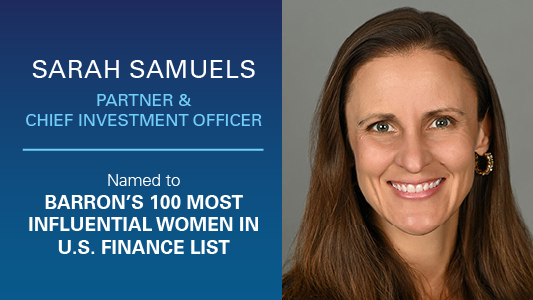
Barron's: Sarah Samuels' 100 Most Influential Women in Finance Profile
NEPC’s Chief Investment Officer, Sarah Samuels, was recognized in Barron’s 2026 “100 Most Influential Women in U.S. Finance,” highlighting her leadership and impact across institutional investing. Read her full profile and insights on Barron’s website, or view excerpts below.
In January, Sarah Samuels was promoted to chief investment officer at NEPC, a Boston-based investment consulting firm with $1.9 trillion in assets under advisement.
. . .
“The power of capital is tremendous, and the work that we do truly changes lives,” she says, from helping parents save for their children’s college educations to making sure retirees can live comfortably.
. . .
She says “nonlinear careers‘’ are valuable—she was a German major at the University of New Hampshire and earned an M.B.A. at Boston University. “I encourage people to take some risks with their careers because careers are pretty resilient, and the risks will pay off.”


401k Specialist: NEPC Rolls Out ‘Stratum One’ Pooled Employer Plan
NEPC’s newly launched Stratum One Pooled Employer Plan is featured in 401(k) Specialist, highlighting how the firm is partnering with Empower and NPPG to deliver an integrated, institutionally governed defined contribution solution. Read the full article on 401(k) Specialist to learn more about how Stratum One is designed to simplify plan management and improve participant outcomes.
Investment consultant and outsourced chief investment officer (OCIO) provider NEPC today announced the launch of a new a Pooled Employer Plan (PEP) called Stratum One, which will be available beginning May 1, 2026.
. . .
“Retirement plans have become increasingly complex for both employers and advisors to manage, and Stratum One was designed leveraging NEPC’s three decades of managing defined contribution plans across market cycles,” said Mikaylee O’Connor, Partner and Defined Contribution Team Leader at NEPC. “We’re excited to partner with Empower and NPPG to provide a true end-to-end offering spanning investments, recordkeeping, administration, and compliance within a single, well-governed framework that can accommodate varying plan designs and evolving employer needs.”
To read the full article, visit the 401k Specialist website.

NEPC Launches Pooled Employer Plan to Simplify Retirement Plan Management
Stratum One centralizes fiduciary oversight, reduces administrative burden, and delivers institutional pricing through NEPC, Empower, and NPPG
BOSTON, Mar. 16, 2026 – NEPC, LLC (“NEPC”), a leading investment consultant and outsourced chief investment officer (OCIO), today announced the launch of Stratum One, a Pooled Employer Plan (PEP) designed to simplify retirement plan management and improve participant outcomes through fiduciary discipline, operational excellence, and market-leading technology.
Stratum One brings together a group of specialized partners to deliver a cohesive, institutionally governed defined contribution solution. NEPC will serve as the Pooled Plan Provider and 3(38) investment fiduciary, Empower will provide recordkeeping and advanced technology capabilities, and National Professional Planning Group (NPPG) will act as the independent 3(16) administrative fiduciary. By leveraging the scale of NEPC’s OCIO platform, Stratum One provides access to competitive investment pricing and disciplined oversight of plan investments, supporting better long-term outcomes for participants.
Together, the firms provide an integrated solution that addresses the growing complexity, risk, and internal resource demands associated with managing defined contribution plans, reducing administrative burdens for plan sponsors and advisors and allowing more time to focus on strategic advice, client relationships, and participant outcomes.
“Retirement plans have become increasingly complex for both employers and advisors to manage, and Stratum One was designed leveraging NEPC’s three decades of managing defined contribution plans across market cycles,” said Mikaylee O’Connor, Partner and Defined Contribution Team Leader at NEPC. “We’re excited to partner with Empower and NPPG to provide a true end-to-end offering spanning investments, recordkeeping, administration, and compliance within a single, well-governed framework that can accommodate varying plan designs and evolving employer needs.”
Stratum One will be available beginning May 1, 2026.
About NEPC, LLC
NEPC, LLC is a leading investment consultant, private wealth advisor, and OCIO provider, serving over 400 retainer clients and $1.9 trillion in total assets as of January 1, 2026. Combining a proprietary investment team dedicated to the long-term challenges facing investors with our client-centric model, NEPC builds forward-looking investment portfolios for institutional investors, ultra-high-net-worth individuals, and families. To learn more, visit nepc.com.
About Empower
Recognized as a leader in retirement services and wealth management, Empower administers approximately $2.0 trillion in assets for almost 20 million individuals through the provision of workplace and individual retirement plans, advice, financial planning, and investments. Connect with us on empower.com, Facebook, X, LinkedIn, TikTok, and Instagram.
About National Professional Planning Group, Inc.
NPPG and its affiliate companies offer full-service employee benefit consulting, retirement planning, actuarial consulting and ERISA fiduciary services. NPPG handles billions of dollars in assets for thousands of clients nationwide.
A full suite of compliance services including retirement plan third party administration for single employer plans, Multiple Employer Plans (MEPs) and Pooled Employer Plans (PEPs), overall regulatory consulting, plan correction, ERISA 3(16) administrative fiduciary services and Affordable Care Act (ACA) consulting.
NPPG customizes solutions to meet business and financial goals of its clients. NPPG clientele is made up of members of the New York stock exchange and NASDAQ, non-profit organizations, Fortune 500 companies, government agencies, as well as small entrepreneurial businesses, associations, and Professional Employer Organizations (PEOs). For more information, please visit www.nppg.com.
Media Contact:
Chaneigh Bernard
Prosek Partners
[email protected]

Barron's: 100 Most Influential Women in U.S. Finance
NEPC Chief Investment Officer Sarah Samuels has been named to Barron’s 2026 list of the 100 Most Influential Women in U.S. Finance, which recognizes leaders shaping the future of investment management and financial markets. Read the full Barron’s article to learn more about the honorees and their impact across the financial industry.
In Greek mythology, the goddess Athena offered guidance and mentorship during periods of uncertainty and transition. The people on Barron’s 2026 list of the 100 Most Influential Women in U.S. Finance are modern-day Athenas, helping their firms, clients, investors, and in some cases, the country, through a period of unusual geopolitical, technological, and economic flux.
Our annual list honors established and emerging leaders in finance, economics, policy, and the corporate world. This year’s honorees are identifying and funding tomorrow’s artificial-intelligence beneficiaries, brainstorming new types of investment products, shaping financial advice for the next generation, and ensuring that monetary policy keeps the economy on an even keel.
. . .
Powerful investment industry gatekeepers are also on this year’s list. Sarah Samuels, chief investment officer at consultant NEPC, has added a diverse array of money managers and investment strategies to the menu from which the firm’s pension, foundation, endowment, and other institutional clients choose.

S&P Global: Private Markets 360 Podcast: Sarah Samuels on Navigating New Frontiers of Private Markets
NEPC CIO Sarah Samuels recently joined S&P Global Market Intelligence Private Markets 360° podcast for a discussion with Jocelyn Lewis and Chris Sparenberg on navigating new frontiers of today’s private marketplace. Listen to the podcast on the S&P Global website.
“In this episode of Private Markets 360°, we welcome Sarah Samuels, Chief Investment Officer at NEPC. With a diverse background in managing endowments, family offices, and public pensions, Sarah discusses the dynamic nature of capital raising, the importance of due diligence, and innovation. She highlights opportunities in the lower middle market, the convergence of public and private markets, and the impact of economic disruption on investment strategies. Drawing on her experience as Chair of the CFA Society Boston, Sarah shares her passion for education and financial literacy, which inspired her to author a children’s book on money and role models.”

Crain Currency: Multifamily offices shift billions to private equity, infrastructure in 2026
Wealthy families are abandoning the traditional 60/40 portfolio for a new allocation model — one that devotes 30% to alternatives, from private equity and infrastructure to hedge funds and secondaries. As multifamily offices enter 2026, they’re betting that differentiated returns lie in private markets, not public ones, and they’re building portfolios with longer time horizons and less liquidity to match.
. . .
Karen Harding, partner and private wealth team leader at Boston-based investment consulting firm NEPC, said pricing in the secondaries market remains strong for sellers, particularly those holding funds with high-performing companies. Buyers, however, should temper expectations. “If you’re buying secondaries, your expectations should be lower than if you’re building out your own direct portfolio of PE funds.” Direct secondary purchases can be attractive but often require general partner approval, which can complicate transactions.
. . .
Harding said she expects pre-IPO and M&A activity to accelerate, suggesting that a SpaceX IPO could “open the floodgates” after years of remaining private.
. . .
Harding was more cautious, noting some recent red flags due to the increase in defaults and some large outflows, as well as lower interest rates reducing their returns. “When people were first really excited and putting all their money in, interest rates were higher. And now rates have come back down. So what they thought they were going to get, they’re getting less today as a piece of it.”
Click here to continue reading the full Crain Currency article.
Buyouts: Endowment returns remain steady despite pressures – NEPC, NACUBO
NEPC’s Colin Hatton was recently quoted in Buyouts discussing the latest NACUBO and NEPC endowment reports, which highlight steady returns across U.S. institutions, the outperformance of public equities, and improving stability in private markets amid ongoing budget and liquidity pressures. Read the full article on the Buyouts website
Endowment reports released by both the National Association of College and University Business Officers (NACUBO) and NEPC showed steady returns for endowments in the US, a relief for CIOs after what has been a tumultuous year for the LP class.
. . .
Public equities stood out as driving the yearly performance for mega endowments – those with at least $1.8 billion in AUM – according to NEPC’s survey. Non-US equity, global equity, EM equity and large-cap US equity all generated over 15 percent returns on the year, according to NEPC data.
That stands in contrast with private markets returns. Venture capital, credit and private equity all returned between 11.5 and 9.5 percent on the year.
But NEPC principal Colin Hatton told Buyouts that there is room to be optimistic about private markets. “If you look at even the weakest-performing large asset class, you still got a positive return out of areas like fixed income, ” he said. “Public equities obviously did very well, and private markets bounced back a bit, and they’re starting to show some much-needed stability going forward.”
. . .
Both Anson and Hatton agree that endowments could engage in more secondaries activity as the year progresses and liquidity concerns continue to mount.

401k Specialist: DC Plans Trend to Passive TDFs as More Terminate Managed Accounts
NEPC’s 20th Annual DC Plan Trends & Fee Survey was recently featured in 401(k) Specialist, highlighting key shifts in target-date fund adoption, managed account usage, and growing interest in alternative investments within defined contribution plans. Read the full article on 401(k) Specialist’s website to explore the findings and industry implications in more detail.
Findings from NEPC’s Defined Contribution (DC) Plan Trends Survey analyzed shifts in plan participant behavior, including how accountholders are investing retirement savings.
. . .
“As target date funds represent a growing share of participant assets and contributions, plan sponsors are placing greater emphasis on glidepath construction, cost efficiency, and how default strategies address longevity risk,” said Emma O’Brien, partner at NEPC.
. . .
“Where private assets are used, sponsors tend to incorporate them selectively through custom solutions,” said Mikaylee O’Connor, partner and DC Team Leader at NEPC. “The emphasis remains on understanding how these assets function within a DC framework and ensuring they align with fiduciary objectives.”
Click here to continue reading the full 401(k) Specialist article.

NEPC’s 20th Annual Survey Reveals Two Decades of Evolution in Defined Contribution Plans
Milestone survey underscores shift toward passive TDFs, fee compression, and selective use of alternatives
BOSTON, MA – February 17, 2026 – NEPC, LLC (“NEPC”), a leading investment consultant and outsourced chief investment officer, today released findings from its 20th annual Defined Contribution (DC) Plan Trends Survey, which examines innovations across DC plans and notable shifts in participant behavior. The survey reveals a sustained shift toward passive target date funds (“TDFs”), an increase in managed account terminations, continued fee compression, changes in US large cap equity structures, and a selective approach to alternative investments.
Two decades of growth and fee compression
To mark the survey’s 20th year, NEPC analyzed key metrics over the last two decades to examine the growing role that DC plans play in retirement outcomes. Over this period, DC plans in the survey expanded significantly, with plan assets growing 27-fold while the number of participants increased 8-fold.
This growth has been accompanied by sustained fee compression, as investment management fees have declined by approximately 67% over the past 20 years, driven by scale, competition, and changes in plan design. Recordkeeping fees also continued to trend lower, decreasing by 26% over the past decade.
“Viewed over a 20-year horizon, these trends reflect structural change rather than cyclical market effects,” said Emma O’Brien, Partner at NEPC. “Plan growth and fee compression are the result of deliberate sponsor decisions and ongoing refinement of the DC model.”
Shift toward passive and blended TDFs
TDFs continue to anchor DC plan design, with this year’s survey showing a sustained transition away from fully active strategies toward blended and passive implementations. Today, 59% of plans offer passive TDFs, reflecting lower implementation fees and increased glidepath risk-level flexibility available from passive providers.
“As target date funds represent a growing share of participant assets and contributions, plan sponsors are placing greater emphasis on glidepath construction, cost efficiency, and how default strategies address longevity risk,” said O’Brien.
Movement in the US large cap equity space
In the past five years, approximately one-third of DC plan sponsors have made a change to their US large cap equity options – an asset class that represents the largest share of participant assets outside of TDFs. These changes reflect the broader movement toward passive strategies, particularly within large cap growth, as well as a reassessment of traditional style-box offerings, such as value and growth.
Increased index concentration within U.S. large cap equities has contributed to these shifts, as active managers have faced growing challenges in consistently outperforming benchmarks. As a result, plan sponsors are reevaluating whether active management and style segmentation continue to deliver sufficient value within DC menus.
Managed accounts face increased scrutiny
Over the last three years, 14% of DC plans have terminated their managed accounts services. These decisions reflect more formal fiduciary reviews as DC governance has matured, along with heightened fee sensitivity and closer evaluation of participant engagement and personalization.
Plan committees are reassessing whether managed accounts deliver sufficient value relative to their cost.
Custom solutions and alternative investments remain selective
As interest in alternative investments continues to grow in today’s marketplace, 21% of DC plans use custom solutions, where exposure to private assets is more likely to occur. Within custom TDFs, private real estate is the most commonly used private asset, with 58% of custom TDF clients allocating to the asset class.
Interest in other private assets remains measured. While asset managers have increasingly promoted private equity and private credit solutions, DC plan sponsors continue to approach these offerings more cautiously, focusing on fees, liquidity, operational complexity, and participant suitability.
“Where private assets are used, sponsors tend to incorporate them selectively through custom solutions,” said Mikaylee O’Connor, Partner and DC Team Leader at NEPC. “The emphasis remains on understanding how these assets function within a DC framework and ensuring they align with fiduciary objectives.”
About NEPC’s 20th Annual Defined Contribution (DC) Plan Trends and Fee Survey
The survey explores current investment trends, features, and innovations in key sectors, as well as how these plans have developed over time. Respondents to the 2025 survey include 148 clients representing $448 billion in aggregate assets and 3.2 million plan participants.
NEPC’s DC team will discuss the survey’s findings during a webinar on February 17, 2026. Those interested in hearing how NEPC is advising plans can register for the webinar here.
The 20th Annual Defined Contribution (DC) Plan Trends and Fee Survey results can be downloaded here.
For additional information, please refer to the latest insights from the DC Solutions team here.
About NEPC, LLC
NEPC, LLC is a leading investment consultant, private wealth advisor, and OCIO provider, serving over 400 retainer clients and $1.9 trillion in total assets. Combining a proprietary investment team dedicated to the long-term challenges facing investors with our client-centric model, NEPC builds forward-looking investment portfolios for institutional investors, ultra-high-net-worth individuals, and families. To learn more, visit nepc.com.
Media Contact:
Prosek Partners
[email protected]

Pensions & Investments: Top retirement plans see third year of gains, but concentration risks pose new challenges
NEPC’s Aaron Chastain, partner and corporate solutions leader, was quoted in Pensions & Investments’ latest annual survey examining asset growth, allocation shifts, and evolving alternative investment strategies among the largest U.S. retirement plans. Read the full article on Pensions & Investments’ website to explore the trends shaping plan sponsor portfolios.
U.S. retirement plans in Pensions & Investments’ latest annual survey reported positive gains in assets for the third year in a row, despite considerable market volatility.
. . .
After years of rapid growth as pension funds have built their alternative asset classes from scratch, those allocations have now settled a bit and sponsors say their discussions have evolved to topics around the construction of those existing portfolios, said Aaron Chastain, partner and corporate solutions leader at investment consultant NEPC.
“So we’ve got a private equity book. How do we make sure we re-up with strong GPs? How do we think about trimming our roster in some circumstances?” said Chastain.
In private debt, for example, a few years ago direct lending was a much smaller subset of investment managers.
“It was relatively easy to choose strong managers. Expected returns were all very similar,” said Chastain. “Now we’re focused a lot more on the portfolio construction aspect of whether you want regular direct lending, or are you thinking about other types of strategies that have come to market a little bit more specialized and nuanced? That may be more appropriate going forward, have a better return opportunity.”
Plan sponsors are much more focused now on manager selection, he said.
“With a lot more players in the space, it’s going to be very important to make sure you’ve got strong underwriting capabilities and you’re not going with covenant-lite managers that may be newer entrants and don’t have as much negotiating leverage. That’s where the focus is. It’s more to looking at within alternatives, rather than, ‘Let’s just continue to increase them at all costs.’”
Click here to continue reading the full Pensions & Investments article.