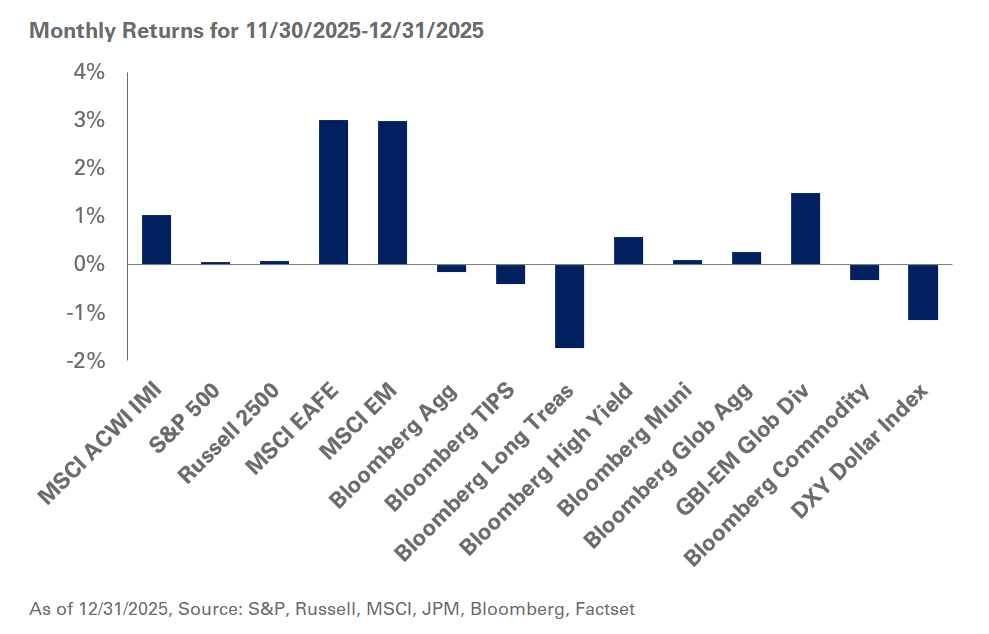
Equity markets were in the black in December, with the S&P 500 adding a modest 0.1%; value stocks outperformed growth equities amid heightened scrutiny around the valuations of AI companies.
International equities sustained their rally with a weakening U.S. dollar providing a tailwind. The MSCI ACWI ex-U.S. Index finished the month with returns of 3%, while the MSCI EAFE Index also gained 3%. During this period, the MSCI Emerging Markets Index—led by Korea and Taiwan capitalizing on the AI theme—was up 3% as well.
Meanwhile, fixed-income markets were in the red in December despite the Federal Reserve lowering the fed funds rate to the 3.5%-3.75% range. During this period, the yield curve steepened with the 10-year Treasury yield climbing 15 basis points to 4.17% and the 30-year yield up 18 basis points to 4.84%.
Real assets saw mixed results with gold emerging as the clear winner as the precious metal briefly hit a record high of over $4,500/oz, ending the month with gains of 7.8%. Gold’s steep ascent underscored the desire of central banks to decrease exposure to the U.S. dollar and increase domestic reserves. The Bloomberg Commodity Index finished the month with a slight loss of 0.3% with natural gas bringing down the index with losses of 23.9%.
Given recent market dynamics, we encourage investors to remain disciplined, stick to long-term strategic asset allocation targets, and maintain exposure to equities. We advocate seeking opportunities to rebalance across equities; we also suggest investors rebalance back into weaker areas of the equity market, potentially using non-U.S. stocks that have outperformed as a funding source. In addition, look to balance exposure to the earnings power of the largest S&P 500 names with value and quality companies across the globe.
At the same time, we advise being mindful of portfolio equity positions, while monitoring outsized tracking error levels associated with the top 10 names of ACWI IMI, and any underweights flowing through. We also recommend investors hold high-quality, liquid assets, and encourage maintaining appropriate safe-haven fixed-income exposure for liquidity and downside protection.