This article is part of NEPC’s Investment Conference Insights series, featuring perspectives from our investment professionals on the key themes, market trends, and investment challenges discussed at the 2026 NEPC Investment Conference.
Session Highlights
- Cash flow timing is the new priority. With distributions slowing and valuations stalling, the operational environment for LPs has shifted. Managing liquidity and modeling realistic cash flow scenarios is critical.
- Secondaries have evolved. The secondary market is no longer a last resort for distressed portfolios. It has evolved into a portfolio management tool that LPs can use to manage risk, generate liquidity, and rebalance exposures.
- Structure creates confidence. Markets have evolved faster than most governance models. Having a detailed playbook to anticipate and address potential challenges will allow investors to make faster, more proactive decisions.
Managing a private equity portfolio today feels inherently harder than it did just a few years ago. For institutional investors, this friction is not merely a perception – it appears to be the result of real, compounding changes.
In the investment environment, interest rates have risen and the economy feels less certain. We see many investors struggling with liquidity and asking tougher questions about valuations as they receive fewer distributions. At the same time, we are seeing more money flow into the private equity marketplace from individual investors into an expanding range of private equity vehicles.
This conference session discussed today’s market challenges and provided case studies of institutional investors that have successfully gotten their portfolios back on track. The lesson: the private equity model remains compelling, but the current environment demands a change in approach to portfolio construction.
Uncomfortable Conditions
Consider the multiple pressures that institutional investors are feeling. Current private equity holdings seem to be stuck in neutral. Valuations haven’t collapsed, but they appear to have largely stalled out. More importantly, fund distributions have not materialized as expected.
From a portfolio construction point of view, it’s been difficult to chart a path forward given overall market dynamics. It seems clear to us that fundraising has reset from the peaks of 2021 and 2022, but capital has not left the system. We have seen dry powder steadily accumulate for more than a decade, creating a growing disconnect between available capital and deployable opportunities.
At the same time, distributions are harder to generate. The IPO window has largely remained closed, and while M&A activity is showing signs of life, the broader exit environment remains sluggish. Because there are fewer forced resets in the market, we believe that timing – rather than pricing – has become the main variable in portfolio outcomes.
For institutional investors, we see these dynamics translating into tangible operational challenges. For example, endowments and foundations are feeling greater pressure to fund their grant-making activities as recipient organizations see other funding sources dry up. When institutions must fund near-term cash flow needs out of long-term assets, tension builds. Decision-making feels heavier because the cost of being wrong feels higher.
In our experience, private equity has delivered its strongest relative performance coming out of market and economic dislocations. Periods of uncertainty tend to reward patient capital with attractive risk-adjusted returns. So instead, we are seeing many institutional investors seeking ways to manage through the challenges. For example, they are maintaining strict discipline on pacing plans, emphasizing high-conviction managers, and becoming far more proactive in how they manage exposures.
Solution #1 – Using Secondaries
An increasingly common option for LPs seeking liquidity is the secondary market, where investors can buy or sell interest in existing private equity funds. Historically, some investors viewed secondary sales as a potential signal of fund-specific concerns. However, as the secondary market has matured, we’ve seen attitudes toward secondaries change significantly.
The following data from Jefferies Global Secondary Market Review 2025 shows the trend clearly. As primary markets have slowed and exits remain challenged, the secondary market has reached record volumes. We believe that’s because LPs and GPs are actively using secondaries to adjust portfolio risk and liquidity without disrupting the overall portfolio allocation. We’ve also seen secondary pricing remain surprisingly resilient, reinforcing that this is a valuation-driven tool, not a distressed one.
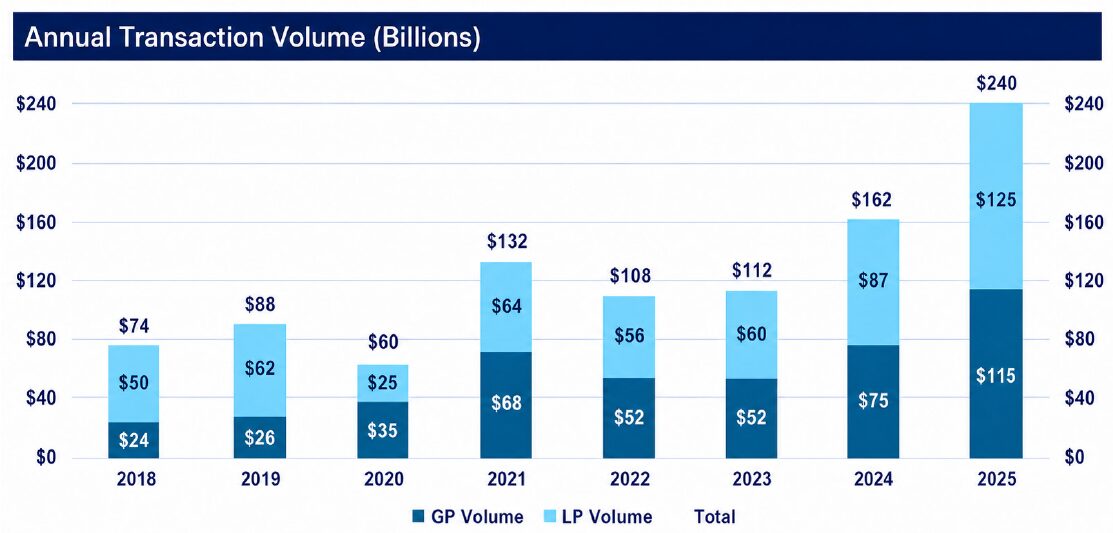 Source: Jefferies Global Secondary Market Review 2025. Through 12/31/2025.
Consider the case of a recent NEPC client who experienced a rapid buildup in their private markets allocation. Their portfolio experienced slower-than-expected distributions, stressing their overall liquidity profile. To address the situation, NEPC worked with the client to plan a secondary sale. By running a guardrail analysis and evaluating scenarios with third-party brokers, NEPC was able to target a position change that restored liquidity and funded upcoming capital calls. Importantly, this strategic move preserved the portfolio’s diversification.
While secondaries are not appropriate for every investor, we have observed that understanding how to utilize them as a proactive portfolio management tool is becoming a prerequisite for sophisticated LPs.
Solution #2 – Making Tactical Changes without Disrupting the Plan
Some institutional investors require complex portfolios to meet the needs of stakeholders. Many community foundations, for example, have multiple pools of assets that are different sizes and have different goals. In addition, community foundation assets are often a combination of endowed assets and donor-advised assets. When portfolio changes need to be made, they can be tactically demanding.
One particular community foundation we work with was looking to transfer assets between two of their pools. The pool they were looking to transfer from had a mature private equity program, while the other pool had just started investing in private equity. In the middle of this transfer, the public markets sold off meaningfully, and their liquidity concerns escalated significantly.
We partnered with the client to step back and evaluate their options. We examined the liquidity profile of the original pool, switching select holdings to get comparable exposures with better liquidity. We also looked at the terms of these various pools and helped them alter some policies regarding how they met donor requests which better aligned with the underlying liquidity profile.
Finally, we reset the pacing plan. We wanted to make sure the foundation could maintain its commitments with high-conviction managers, so we slowed the process down. In the end, this combination of tactical changes helped preserve the foundation’s private equity program while also meeting all withdrawal needs from donors.2
The NEPC Playbook: Structure Creates Confidence
These case studies show that there is no one-size-fits-all strategy when it comes to addressing challenges in a private equity allocation. Sometimes an investment change can solve the problem, while in other cases, a broader strategy is needed.
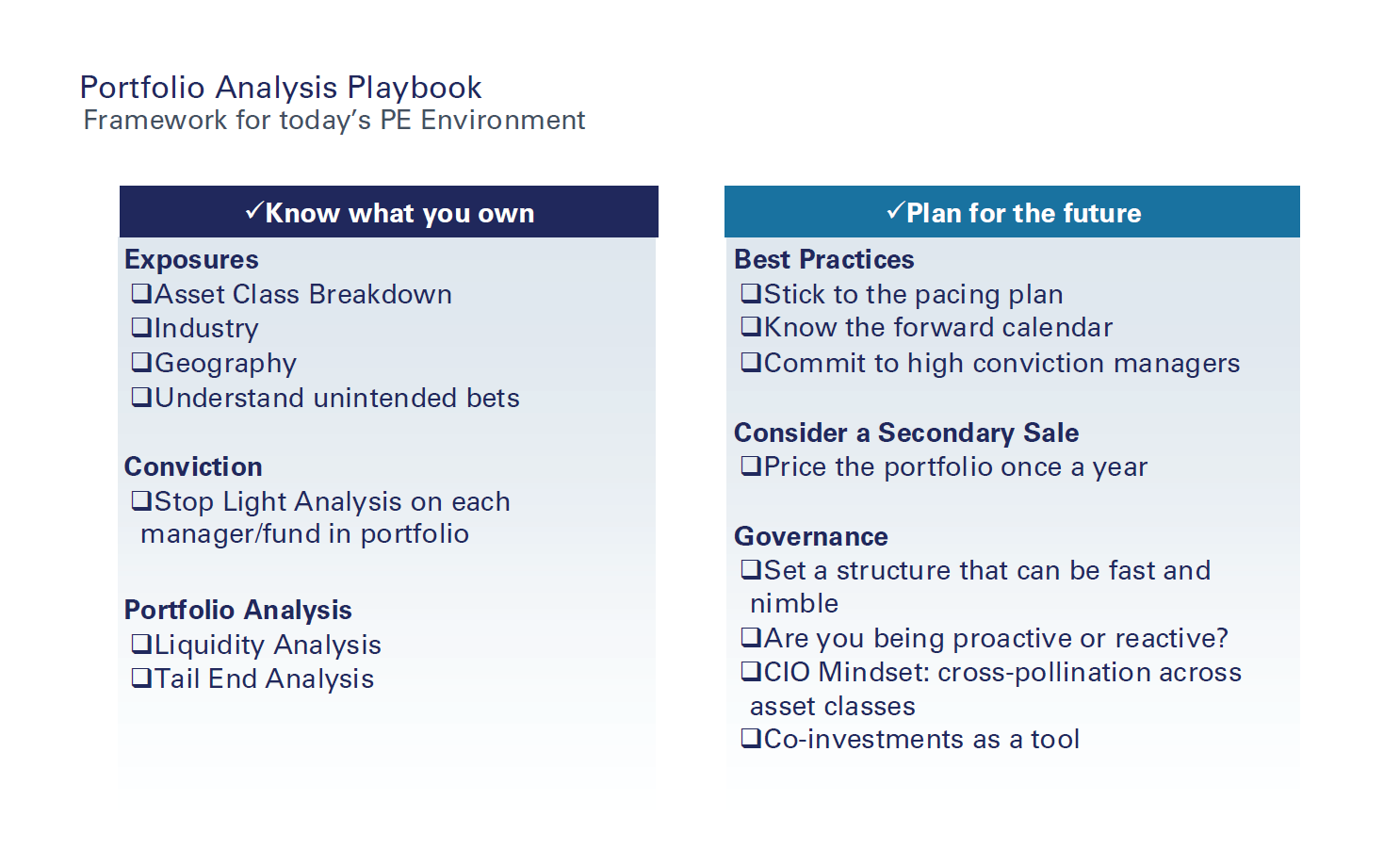
In our view, good outcomes came from having an established structure for evaluating the portfolio, so that you can address issues with patience and clarity. At NEPC, we have developed a playbook to bring structure to portfolio conversations and move forward deliberately.
- Know What You Own: Investors should dig regularly into how the portfolio is behaving – analyzing exposures across asset classes, geographies, and vintages, and understanding how the portfolio is maturing over time.
- Liquidity Analysis: In this environment, LPs cannot assume distributions will show up on schedule. It is vital to model realistic scenarios, including a prolonged slow-exit environment, to identify where pressure points could emerge.
- Tail-End Analysis: As portfolios mature, complexity is often driven by legacy positions that consume time but no longer move the needle on performance. Understanding what is driving value versus what is merely consuming resources is a core tenet of good stewardship.
- Conviction and Prioritization: Investors should conduct a “stoplight analysis” to identify their highest-conviction managers. By mapping out the forward fundraising calendar, LPs can be intentional about leaning into their strongest relationships and ensuring they have the capacity to commit when those managers return to market.
Moving With Purpose
Investing through uncertainty can test even experienced investors. But we believe private equity remains a powerful long-term allocation, especially for those who can execute their programs with precision. Outcomes are increasingly dependent on thoughtful positioning, robust governance, and the flexibility to act deliberately.
2The above is an illustrative example of a client’s experience with NEPC. Past performance is not indicative of future results. The above example is intended for discussion purposes. Please see additional disclosures throughout these materials.