This article is part of NEPC’s Investment Conference Insights series, featuring perspectives from our investment professionals on the key themes, market trends, and investment challenges discussed at the 2026 NEPC Investment Conference.
Session Highlights
- Operational alpha over investment alpha. Across the asset management industry, AI is primarily being used to drive operational efficiency, scale research, and protect margins. Currently, 0% of surveyed firms are delegating final investment decisions to AI.
- Governance dictates adoption. Institutional investors are prioritizing sequencing and data controls. Adoption varies significantly by plan type, with many organizations waiting to establish robust governance frameworks before experimenting.
- Amplifying human expertise. Firms like NEPC are deploying AI for high-value, labor-intensive workflows to free up investment professionals for strategic decision-making and fiduciary
Artificial intelligence dominates today’s financial headlines. For institutional investors, it is nearly impossible to read a market commentary or attend an event without encountering sweeping AI predictions. Yet, when we examine real ways that AI is being utilized, a more nuanced reality emerges.
As a consultant at the intersection of asset managers and a diverse institutional client base, NEPC occupies a unique vantage point. The consensus? AI is being actively deployed, and the pressure is on to expand its usage. However, most of the investment managers we surveyed believe its utility lies not in replacing human judgment, but in driving operational efficiency, scaling research, and empowering investment professionals to focus on high-value, strategic decision-making.
This conference session brought together NEPC experts to dissect exactly how AI is being used across the investment ecosystem. By analyzing experience, policies, and survey data, NEPC sought to highlight the drivers and limitations that are impacting AI usage across asset managers, institutional investors, and NEPC itself.
Asset Manager Use Cases – Better Margins Through Efficiency and Scale
Following the Global Financial Crisis in 2008, the asset management industry enjoyed a prolonged period of tailwinds: lower interest rates, consistent GDP growth, and robust capital markets. Today, those tailwinds have largely reversed. At the same time, the industry has been battered by new structural challenges, such as the migration from active to passive management, the rise of alternatives, and persistent downward fee pressure. According to a McKinsey study, margins for North American asset managers have declined significantly over the past five years, leading to industry consolidation and strategy closures1. As a result, asset managers largely view AI as a once-in-a-generation opportunity to restore profitability.
To separate fact from fiction, NEPC’s research team surveyed over 230 firms in the first half of 2026 about their AI usage, across public markets, private markets, and hedge funds, representing well over
$100 trillion in assets under management. The results revealed that while AI adoption is widespread, it remains relatively shallow and is largely restricted to generating efficiency and scale.
- AI is ubiquitous in general research, with 82% of respondents utilizing AI tools to generate more research at a faster pace.
- Asset managers are comfortable using AI for automated systems or data Specifically, 65% of respondents noted that their portfolio management teams are using AI for use cases such as building financial models.
- However, as you move closer to the actual management of capital, AI usage drops precipitously. Only a third of respondents use AI for trading and risk management, and 0% of firms indicated they rely on AI for final investment decision-making.
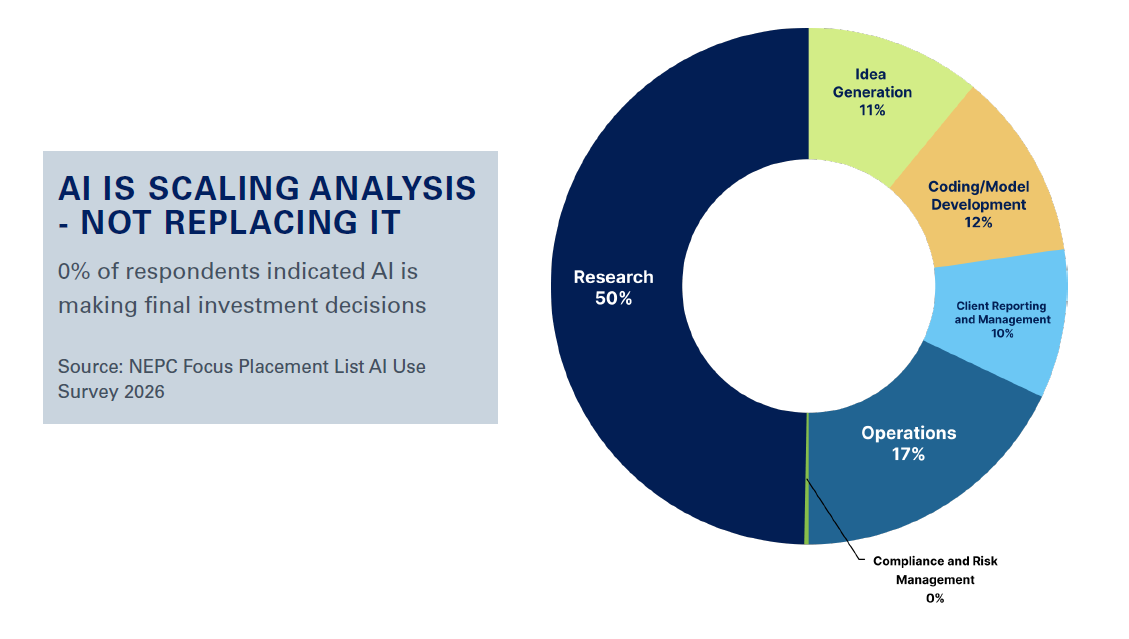
To us, this data suggests that managers are confident in their AI models precisely because they are constraining them. AI is currently transforming everything around investing, rather than transforming the investment decisions themselves.
Institutional Investor Policies – Governance Before Experimentation
NEPC then turned our attention to institutional investors themselves. Our AI survey also included 45 clients, spanning endowments, foundations, public pensions, healthcare systems, and private wealth organizations, with assets ranging from sub-$500 million to over $5 billion. We found that AI usage varies significantly, and that it will likely take some time for best practices to emerge.
Across the board, institutional AI adoption is overwhelmingly operational. The most common use cases involve administrative efficiency, such as:
- drafting and reviewing documents
- summarizing workflows
- organizing research
Across all plan types, AI is commonly viewed as a “junior analyst” excellent at scale, speed, and pattern recognition, but entirely reliant on human judgment for context, nuance, and fiduciary oversight.
Survey Results: AI Organization Usage
 When we segment the data by plan type, some patterns emerge. Private wealth organizations exhibit the highest relative use of AI in investment research, while public pensions and Taft-Hartley plans remain materially more conservative, a reflection of their stringent regulatory environments and complex governance layers.
Interestingly, we also observed a “middle-market pause.” Organizations managing between $500 million and $2 billion are currently the least likely to be using AI. We suspect this pause exists because these institutions are large enough to exercise institutional caution, but perhaps not large enough to easily absorb the costs and risks of early experimentation.
Inactivity does not equate to philosophical opposition; many institutional investors are prepared to employ AI tools. But as policy-driven fiduciaries, they are prioritizing sequencing: they want robust governance frameworks and data controls in place before they begin experimenting.
NEPC’s Goal: Drive More Client Value
NEPC’s own approach to AI usage necessarily reflects the ideas and policies we see with our working partners. Like asset managers, we seek ways to build value with AI; like institutional investors, we take care to uphold our fiduciary responsibilities. At its best, AI should be an engine that generates better work, a tool that keeps our capable analysts focused on generating value and that speeds hard-won knowledge into the hands of clients quickly.
That is the mission of NEPC’s AI Center of Excellence, an oversight group that combines professionals from IT, research, and consulting. Our current priority is to seek AI use cases that accelerate repeatable, labor-intensive workflows. A prime example is our manager meeting process.
NEPC conducts over 2,000 manager meetings annually. Historically, our highly experienced researchers spent a significant portion of these meetings focused on taking notes. Today, with the explicit consent of the managers, we deploy an AI note-taker to capture and structure the discussion. This allows our researchers to remain fully engaged in the conversation, asking deeper, more probing questions.
After the meeting, the AI organizes the notes into a structured format. However, it is the analyst who reviews the notes, evaluates the opportunity, and provides the final opinion on what actions NEPC should take. Nonetheless, this straightforward operational change has dramatically improved the speed, consistency, and coverage of our research.
Just as important as where we use AI is where we explicitly do not use it. NEPC does not use AI to:
- make client recommendations
- drive asset allocation, portfolio construction, or capital market forecasts
- generate manager ratings
- handle sensitive client information or trading
We believe that human expertise, contextual understanding, and fiduciary judgment are the core value propositions we provide to our clients. AI is here to amplify that expertise, not replace it.
Watch This Space
The integration of artificial intelligence into the institutional investment process is happening today, but it is largely being used selectively and with care. Across asset managers, institutional allocators, and consultants like NEPC, the most successful adopters are those who prioritize accountability, governance, and human oversight over the allure of novelty.
But that is where we stand today. AI is fueling new ideas, new business models, and new types of competition. We intend to continue monitoring AI use cases and reporting updates in future conferences.
To learn more about how NEPC supports institutions with governance oversight, operational best practices, and proprietary data analytics, reach out to your NEPC consultant today.
1 Godsall, J., Koch, P., Sharma, P., Bector, R., Pingaro, T., & Fedorenko, A. (2025, July 16). How AI could reshape the economics of the asset management industry. McKinsey & Company. https://www.mckinsey.com/industries/financial-services/our-insights/how-ai-could-reshape-the-economics-of-the-asset-management-industry