

Pensions & Investments: DOL’s alts proposal could accelerate the shift to 3(38) fiduciaries in DC plans
Plan sponsors increasingly want advisers to play a bigger role in investment decisions, and the recent Department of Labor proposal on investment alternatives in defined contribution plans could further fuel that appetite.
. . .
Aaron Chastain, partner and corporate solutions leader at NEPC, said the firm’s corporate-client discretionary assets have increased about 4.5 times over the last five years.
. . .
Chastain said he expects some sponsors to keep a 3(21) adviser for most of the plan, while handing off manager selection or operations for a specific sleeve — such as alternatives — to a 3(38) manager.”
“Using an external party or outsourcing doesn’t have to be an all-or-nothing type approach,” Chastain said.


Institutional Investor: Overseas Stocks Drive Double-Digit Returns for State Plans Like Louisiana and New York
Several state pensions have benefited from the surge in non-U.S. equities, including emerging markets.
. . .
According to NEPC’s head of marketable equity research Nedelina Petkova, strong performance from financials, industrials, and defense-related businesses and ongoing improvements in Japan have helped international developed markets. Plus, Petkova wrote that EAFE (Europe, Australasia, and the Far East) performance “has been less dependent on a small number of technology companies and reflects a broader set of economic drivers than the U.S. market.”
. . .

Bloomberg: Cash-Strapped Colleges Are Draining Their Endowments to Survive
Like borrowing from a 401(k), the tactic can help short-term but carries big long-range risks.
. . .
“Once you get much over a spending rate of 7%, consistently, you are an at-risk endowment,” said Kristin Reynolds, who advises endowment administrators on their investment strategies at consulting firm NEPC. She was speaking generally, not about a specific college.
. . .

Pensions & Investments: Why active equities dominated 401(k) plan fund changes in 2025
The ongoing challenges of active management were reflected in 401(k) plan fund changes in 2025, as concentration in large-cap equities and poor performing quality small-cap equities forced some plan sponsors to replace funds, according to defined contribution plan consultants.
. . .
Mikaylee O’Connor, partner and head of defined contribution solutions at NEPC, said among their clients, active growth funds have faced more challenges than active value funds, because of the hurdles of the extreme concentration of the growth index with the dominance of tech stocks.
“(Retirement plan) committees really have responded in different ways. I will say some have moved to passive large-cap growth while retaining active largecap value, and I think that’s a recognition that this has been one of the top performing asset classes, and so they’re reevaluating how (to) actually deliver that to participants,” O’Connor said.
Others, she said, have moved to eliminating any style-specific large-cap funds and simply moved to a passive core allocation.
“I think the main theme there is that committees are revisiting their menu structures. We actually did a little bit more digging into this, and in the last five years, approximately 30% of our clients have made structural changes to their large-cap lineup,” such as swapping out active managers, she said.
“So it’s not just in the last year, but over the last five years, we’ve seen this trend of making some sort of (large-cap) change.”
. . .

Pensions & Investments: DC retirement plan assets drive explosive OCIO growth, and experts say it’s just the beginning
Fewer fiduciary risks, greater access to private markets investments, improved corporate governance and lower costs are among the reasons retirement plan sponsors choose outsourced chief investment officer services, producing an asset surge under OCIO management plus predictions that there’s more to come.
. . .
Fiduciary risk is a “commonly cited reason” when DC sponsors consider OCIO services, said Aaron Chastain, partner and corporate solutions leader for the NEPC consulting firm.
Hiring OCIO services doesn’t eliminate fiduciary risk because sponsors have a fiduciary duty to monitor OCIO activities, and sponsors’ ERISA lawyers are “very involved” in making sure sponsors understand their responsibilities, he added
. . .
For many sponsors, OCIO is “a more efficient way to access alternatives investments,” Chastain said. “It allows sponsors to focus on policy decisions” about which — if any — private markets investment they want to offer. OCIO handles the manager selections, he said.
. . .
“Employers first embraced OCIOs to outsource investment oversight, and PEPs are emerging as the next evolution, enabling them to offload much of the administrative burden of running a retirement plan,” Chastain said. “It allows organizations to focus on their core business while retirement plan experts handle the rest.”
. . .
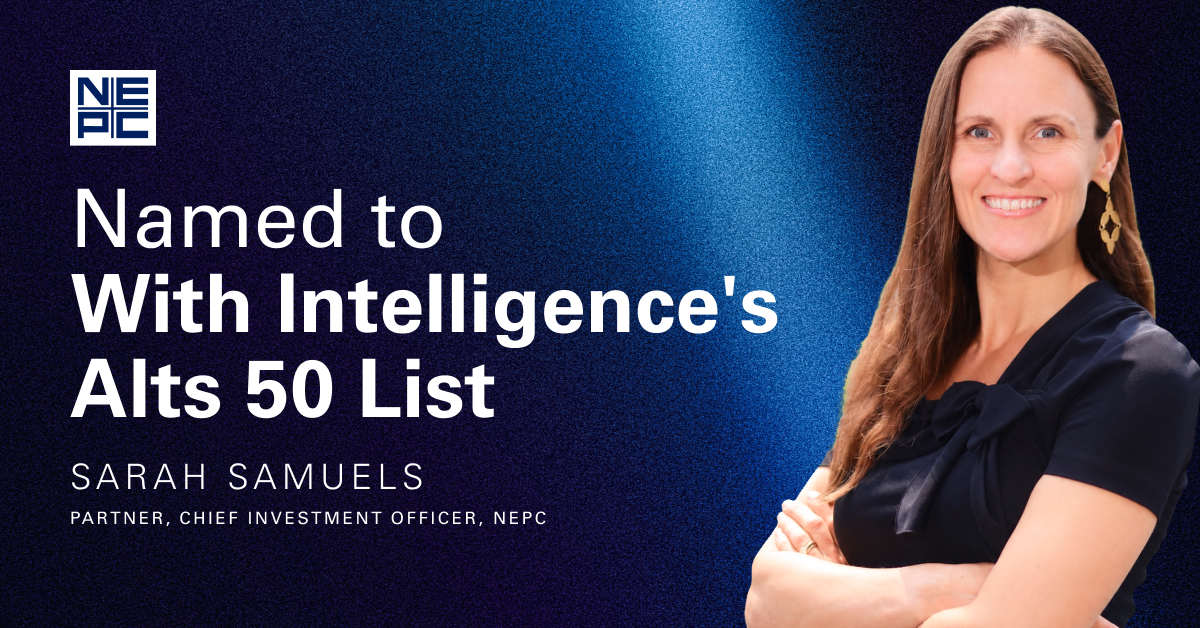
With Intelligence: The Alts 50 List
NEPC Partner and Chief Investment Officer Sarah Samuels, CFA, CAIA, has been named to With Intelligence’s inaugural Alts 50, recognizing the 50 most influential institutional allocators across the alternatives industry. Read the full With Intelligence announcement to learn more about the Alts 50 and this year’s distinguished honorees.
The Alts 50 highlights institutional investors at the forefront of alternatives, recognizing allocators who are driving innovation, influencing capital allocation, and helping shape the evolution of private markets. The inaugural list brings together leaders from across the institutional investment landscape whose expertise and leadership continue to have a meaningful impact on the industry. The inaugural ranking celebrates leaders whose investment decisions, strategic vision, and industry influence are shaping the future of alternative investing. The Top 10 honorees will be revealed live at the Alts 50 Awards Dinner in New York on October 27.
. . .
Sarah Samuels, Chief Investment Officer at NEPC, was recognized among this inaugural group of influential institutional allocators for her leadership and contributions to the alternatives investment community.

Planadviser: The Reality of ‘Frenemies’ in Provider Relationships
Recordkeepers are in a tight spot in the retirement industry.
. . .
It is creating tension in the industry, according to Mike Contorno, principal in and head of defined contribution vendor management at NEPC, an investment consulting firm which does not operate under this business model.
“These issues have become much more prominent in discussions around provider selection and long-term strategy,” Contorno says.
This trend’s impact on day-to-day provider selection remains to be seen, but as consolidation continues and as firms seek greater scale, Contorno says revenue opportunities tied to participant assets and wealth management are becoming increasingly important factors in long-term partnership strategies.
He adds that the most tangible impact is in request-for-proposal pricing: Firms that generate significant revenue from participant assets, rollovers or wealth management services may have greater flexibility to reduce or even waive consulting fees. That is why full disclosure of all related revenue streams would allow plan sponsors a more transparent comparison of potential partners.
“Greater transparency around these revenue streams would help plan sponsors better understand the economic incentives involved and evaluate potential misalignment of interests when selecting a provider,” Contorno says.
. . .
Click here to continue reading the full Planadviser article.

Pensions & Investments: Why small-cap’s revival is punishing active managers and what pension funds are doing about it
Small-cap equities are in the midst of a revival, leading U.S. public pension funds to take a closer look at their active managers that have not kept up with benchmark performance, industry experts say.
. . .
Nedelina (Nina) Petkova, principal and head of marketable equity research at NEPC, said despite the Russell 2000 index’s double-digit gains, lower quality, higher beta and momentum-oriented stocks drove that strong performance.
“On the active manager side, there’s always a preference for quality, profitability, and downside risk discipline, so I think that’s really important as a backdrop,” said Petkova.
. . .
“I think when we look back through history, quality often trails large market rallies. We saw something similar back in 2021 and it often comes back in favor shortly thereafter,” Petkova said.
. . .
“Many of the stocks that are responsible for the majority of these returns have been a specific subset, and many of these names, in particular, have since exited the small-cap index with the latest June reconstitution,” Petkova said.
Going forward, the more frequent reconstitutions will impact the dynamics of the small-cap universe, and Petkova said she sees this as a positive.
“The problem was that rising volatility and an increase in the (rapidity) of winners and losers have led to index style drift, and the move to reconstitutions twice per year should level the playing fields and should help indices stay more aligned with their intended exposures,” Petkova said.
. . .

Institutional Investor: Cambridge, Other Advisors See Spike in Interest in Co-Investments
GPs are increasingly using co-investments to strengthen relationships with LPs, tapping investors’ industry expertise and networks.
. . .
Meanwhile at NEPC, while demand for co-investments has remained relatively consistent, the Hightower-owned advisory firm’s head of private equity investments Josh Beers sees increased interest in large private technology companies thanks to artificial intelligence, though he dismissed a lot of that as headline chasing and FOMO.
“Overall demand for co-investing has largely centered on fee-free exposure and, in some cases, shorter hold periods,” Beers told II in an email. “The increased curiosity around technology names has been driven primarily by headlines and a broader fear of missing out.”
Beers added that allocators can also use co-investments to help diversify their portfolios beyond listed and private companies in tech and AI.”
. . .
Click here to continue reading the full Institutional Investor article.

Pensions & Investments: Passive Fixed Income Continues to Chip Away at Active’s Lead
Active U.S. fixed income still dominates the asset class, but passive strategies are steadily gaining ground in defined contribution plans as sponsors add more index options, consultants say.
. . .
The growth of passive fixed income has been centered on investment options offered in defined contribution plans and is about choice rather than replacement, said Mikaylee O’Connor, partner and DC team leader at investment consultant NEPC, in an interview.
“The percentage of plans offering both active and passive fixed income has increased meaningfully, “ O’Connor said. Five years ago, 59% of the consultant’s DC plan clients offered both active and passive options and now 84% of those clients offer both, O’Connor said.
“Most of that was the addition of passive fixed income,” she said. “So, what that means is sponsors are building mirrored investment menus, so that participants can then choose between active and passive.”
. . .
NEPC’s O’Connor also said another structural force supporting more assets moving into passive fixed income over the past five years is fairly tight performance dispersion.
“If you look at over the last five years, the return spread between the top and the bottom quartile managers within core fixed income has been relatively narrow, so it’s making right essentially harder for active managers to differentiate themselves after fees,” O’Connor said.
This makes passive fixed income an “effective building block,” providing very low fees and similar performance.
“I would say that the difference between core and core plus is wider, but not meaningfully, compared to what you see in the U.S. equity or international equity space,” she said.
. . .
Click here to continue reading the full Pension & Investments article.